Is an Amazon Black Friday deal profitable? The 2026 cost stack, fee by fee
Is your Amazon Black Friday deal profitable? The US fee stack for 2026, a worked break-even test, and what to check before the 20 October deadline.

- 12 min read
- FBA & Operations
Fact-checked against Amazon's own pages on 11 Oct 2026
On this page
The short answer
- The fee is the small part of whether an Amazon Black Friday deal is profitable: on Amazon.com a deal costs $100 upfront plus 1.5% of promotional sales (capped at $5,000), and Amazon says the upfront set-up fee is charged whether or not you sell a unit, unless the deal is cancelled before it starts.
- The discount is the big part: Amazon sets a minimum of 15% off the ASIN reference price for a Best Deal, 20% for a Lightning Deal and 15% for a Prime Exclusive Price Discount, and that comes straight out of your unit profit.
- Peak fees shrink the margin first: holiday peak fulfillment fees run from 15 October 2026 to 14 January 2027, averaging $0.32 more per unit, with a 3.5% fuel and logistics surcharge on top.
- The test is a multiple: divide your normal unit profit by your profit per deal unit. That is how many times more units the deal period has to sell just to stand still.
- Selection is not guaranteed: Amazon says it cannot guarantee a deal will be selected for the event, so price the version that runs on the week-long dates too.
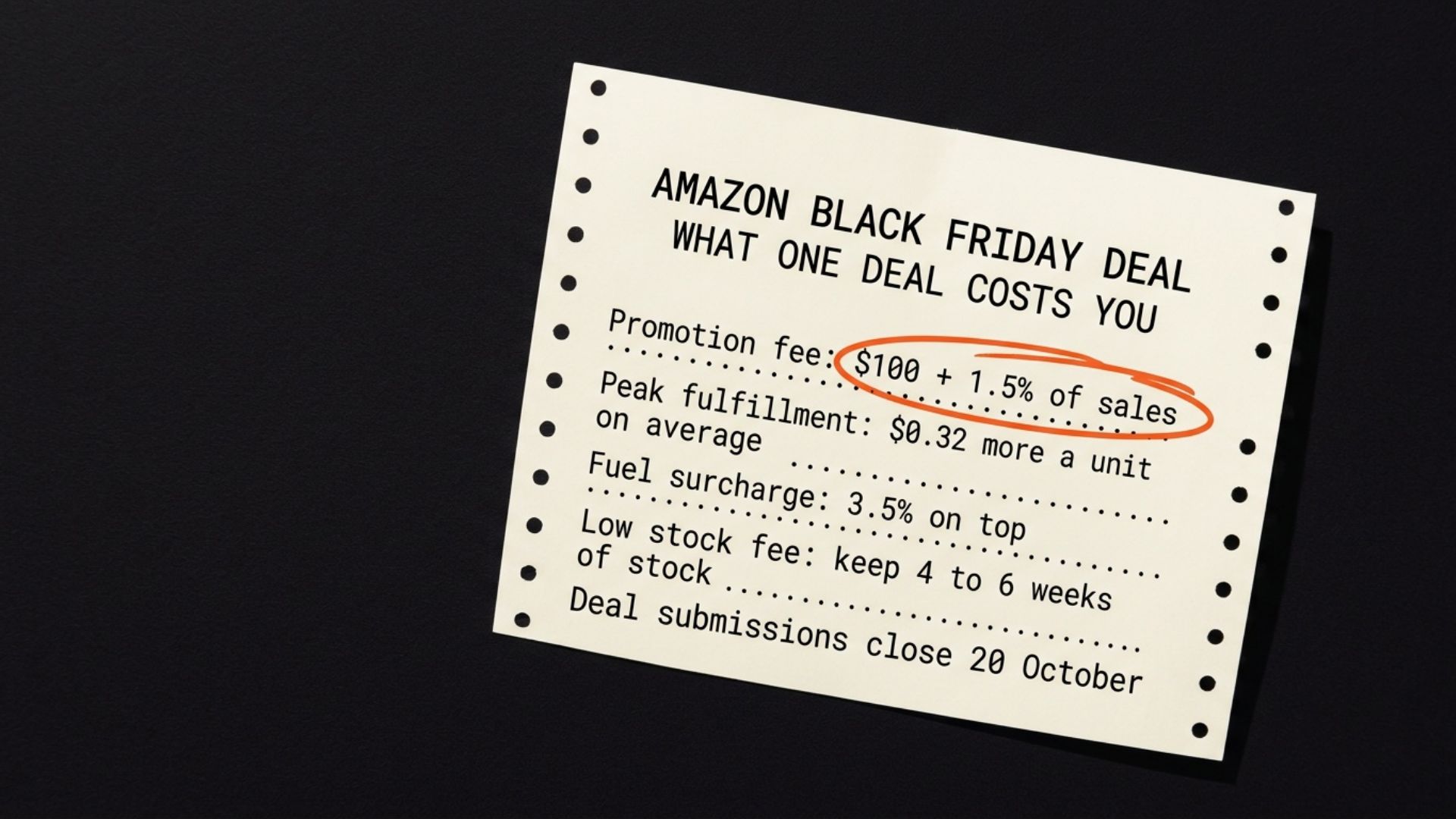
Amazon’s published fee for a Black Friday deal is $100 upfront, plus 1.5% of promotional sales, and its help page says the fee shown when you schedule can vary with the traffic period. Whether an Amazon Black Friday deal is profitable has very little to do with that number. In the worked example further down, it comes to under a dollar a unit.
The US window for Black Friday Week and Cyber Monday deals closes on 20 October 2026, so the decision has to be made in the next few days, with one fresh data point: how your own ASINs behaved on Prime Big Deal Days, which ran on 6 and 7 October. This guide lays out what a deal actually costs on Amazon.com, how to put those costs next to your own margin, and the order I would work through before pressing submit.
The 20 October close is Amazon’s date for Best Deals and Lightning Deals; its playbook gives Prime Exclusive Price Discounts an opening date and no closing date. This guide is about cost, not dates. For the deadline itself, the Max Price rules and what suppresses a scheduled deal, our Black Friday deal deadline guide goes through them.
Why an Amazon Black Friday deal can lose money even when it sells out
A deal works by trading margin for volume. That is the whole mechanism, and it is a good trade when the volume is large enough and the margin is wide enough. It stops being a good trade quietly, because the sales report looks wonderful either way. A deal that loses money on each unit still has a badge and a spike on the graph.
Three things make a Black Friday deal in 2026 harder to read than an ordinary one:
- The costs arrive in different places: the promotion fee appears in the Payments report, the fulfillment fees sit in your fee previews, and the discount never appears as a cost at all, because it is simply a lower price.
- The peak fees land on the margin you discount from: they come from the season, not from the deal. They matter because they make the profit that the discount is taken out of smaller.
- The inventory rules cost money if you get them wrong: Amazon’s playbook advises having 4 to 6 weeks of stock before a deal event to avoid a low-inventory-level fee.
What does an Amazon Black Friday deal cost in 2026?
The table below is for Amazon.com. Each line comes from Amazon, and I have kept my own reasoning separate from what Amazon says.
| Cost | What Amazon says |
|---|---|
| Promotion fee | $100 per promotion, plus 1.5% of promotional sales, capped at $5,000, for Best Deals, Lightning Deals and Prime Exclusive Price Discounts |
| Peak fulfillment fee | Applies from 15 October 2026 to 14 January 2027 to FBA, Remote Fulfillment with FBA, Multi-Channel Fulfillment and Buy with Prime, with the same per-unit increase as last year, averaging $0.32 per unit |
| Fuel and logistics surcharge | 3.5%, applied on top of the holiday peak fulfillment fees |
| Low-inventory-level fee | Amazon’s playbook says to have 4 to 6 weeks of inventory available before a deal event to avoid it |
| Monthly storage | Amazon’s announcement mentions an “off-peak monthly storage rate” for AWD stock with automatic replenishment. I have not quoted a Q4 storage figure because I could not read one on Amazon’s own page, so check the current rate on the storage fee page in Seller Central |
The sources are Amazon’s Holiday 2026 deals and fees announcement on the US Seller Forums and Amazon’s Q4 2026 peak readiness playbook. Two details in them are easy to miss.
The first is that the promotion fee is not refundable by selling nothing. The playbook says: “The set-up fees will be charged upfront, regardless of whether you sell any units while the item is on discount, unless you or Amazon cancels it before the start time.” It later shows up as a “Promotion fee” in your Payments report after a 10-day reconciliation period.
The second is that $0.32 is an average, not a flat charge. Amazon’s announcement says the peak rates for FBA and Remote Fulfillment with FBA are already in the Revenue Calculator, the Profit Analytics dashboard and the Fee and Economics Preview Report, which is where your own ASIN’s number lives. Use that, not the average.
The UK, Germany, France, Italy and Spain are different. Amazon’s Peak season 2026 announcement on the UK Seller Forums sets its own fees in pounds and euros and a Black Friday Week submission window that is open until 18 November. The table is in our deadline guide, and it is worth keeping the two calendars apart.
How to know if your Amazon Black Friday deal is profitable
Here is the test I find easiest to explain. It needs only your normal profit on one unit and the profit on one unit during the deal.
The numbers below are an example I made up to show the arithmetic. They are not Amazon’s numbers and not a client’s. Say an item sells for $40, and after every normal cost including the peak fulfillment fee and the 3.5% surcharge, it earns you $12 a unit.
- Take the discount off the profit: say the deal takes 20% off the $40 price, which is $8. That leaves $4. (Amazon’s own minimum is measured against the ASIN reference price and can be higher during peak events, so read the Max Price field for your ASIN.)
- Spread the promotion fee across the deal units: at 500 units, promotional sales are $16,000 at $32. The variable fee is $240, and with the $100 upfront that makes $340, or $0.68 a unit. That leaves $3.32.
- Divide: $12 normal profit over $3.32 deal profit is about 3.6.
So in this example the deal has to sell about 3.6 times as many units as the same period would have sold anyway before you are even. Above that, the deal adds profit on these numbers. Below it, the extra volume does not cover the discount. Returns, ad spend and any effect on rank are not in this sum. The fee was 68 cents of the $8.68 gap.
The mistake is to count only the day. Whatever the deal sells, count what you would have sold in the same period without it, because some of those buyers were coming anyway and now pay less.
What to check first
The order matters here, because the first check is free and the last one is not.
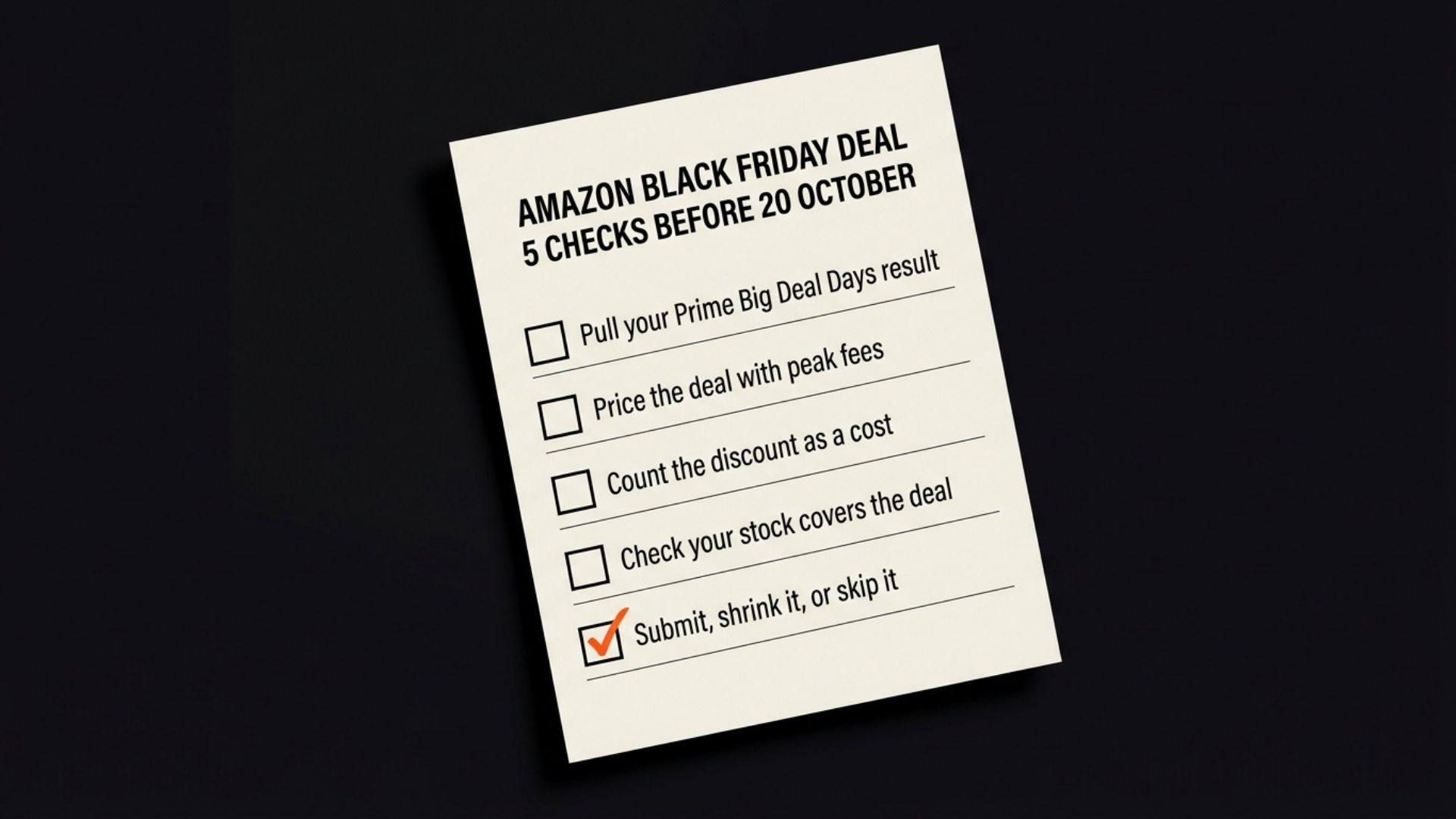
- Your Prime Big Deal Days result, per ASIN: units on the two event days, and the days either side. Amazon says those promotional prices are excluded from the lookback and will not affect your Black Friday maximum deal price, so those prices will not distort your Black Friday maximum price. My own reasoning is separate: the result is the closest evidence you have this year of how that ASIN responds to a discount.
- Your real margin at peak rates: use the Revenue Calculator or the Fee and Economics Preview Report, not last year’s spreadsheet. Peak rates for FBA are already there.
- Your stock around the deal: Amazon’s playbook says to have 4 to 6 weeks of inventory available before a deal event to avoid the low-inventory-level fee, and recommends keeping 28 days afterwards for post-deal sales. Our guide to the Black Friday arrival deadline covers why stock that is delivered is not always stock that is ready.
- What happens if the deal is not selected: Amazon says in its help page: “We can’t guarantee that your deal will be selected to run on the event.” It adds that deals with a greater available quantity and inventory may have an advantage. If a deal is not selected, its dates reflect the week-long timeframe instead of the event name. That is still a discount at a reduced profit, so it needs its own line in the sheet. The help page does not say how the fee is handled for a deal that is not selected, so read the fee shown when you schedule.
The figure below is a five-step summary of this job. Counting the discount as a cost and the final decision are covered in the two sections that follow.
How to decide: submit, shrink it, or skip it
This is reasoning, not an Amazon rule. Once the sheet gives you the multiple for each ASIN, the decision tends to fall into one of three places.
- Submit it: the multiple is small next to what your Prime Big Deal Days result suggests the ASIN can do, and your stock covers the deal with room to spare.
- Shrink it: the ASIN needs the discount to compete but cannot carry the Lightning Deal minimum. Amazon sets the Prime Exclusive Price Discount minimum at 15% against 20% for a Lightning Deal, and the published fee is the same, though the two get different placement, so the lower minimum is worth pricing out and the trade-off is yours.
- Skip it: the multiple is far above what the ASIN has ever done in a promotion, or the stock is not there. Skipping one ASIN is a legitimate choice.
If you decide against a deal after scheduling it, Amazon’s help page says: “If you are unsatisfied with the resulting fee, you can cancel the Deal before the Deal is expected to run.” The fee is shown when you pick the schedule, and it may be higher for a higher-traffic period, so read it before you confirm.
Count the discount as marketing spend
This part is my own method rather than anything Amazon publishes. A discount is money spent to buy a sale, in the same way ad spend is. When you read a deal week, put the discount on its own line beside your ads. TACOS is ad spend over total sales and leaves the discount out, so the extra line is what shows the whole price of the sale.
It also changes how I treat advertising on deal days. Adding bids on top of a discount stacks two ways of paying for the same buyer. Whether that is right for an ASIN depends on its numbers, which is another reason to run the sheet first. Our guide on the three-margin pricing framework explains where the margin figure itself should come from.
How to stop it happening again
- Keep the sheet after the event: write down each ASIN’s multiple and what it really sold. Next year’s decision then starts with evidence instead of memory.
- Re-read the fee announcement every year: this year’s title says “Same fees, same eligibility, earlier deadlines”, which describes 2026 and promises nothing about next year. Our look at the 2026 FBA fee changes covers what changed in January.
- Plan stock before the deal, not after: a deal that wins and then runs out costs more than the discount, and our guide to recovering rank after a stockout covers that cost.
Get your Black Friday deal numbers checked before 20 October
I understand how little time this leaves. The deadline is close, the fees are in several places, and it is easy to submit on instinct. I cannot promise that any deal will make money, and nobody honest can. What I can do is sit down with your Prime Big Deal Days numbers and your real fee previews and tell you which ASINs the arithmetic supports.
Our inventory management service covers the stock side of a deal. For the deal numbers, get in touch and we will go through your Prime Big Deal Days results and fee previews together.
Common questions about Amazon Black Friday deal costs
How much does an Amazon Black Friday deal cost in the US
On Amazon.com, Best Deals, Lightning Deals and Prime Exclusive Price Discounts cost $100 upfront per promotion plus 1.5% of promotional sales, with the variable part capped at $5,000, according to Amazon's Holiday 2026 announcement. Amazon's peak readiness playbook says the set-up fees are charged upfront whether or not you sell any units, unless you or Amazon cancels the deal before the start time. Amazon's help page adds that the fee shown when you schedule can vary with the traffic period.
Do I still pay the fee if my Amazon deal does not sell
On Amazon.com, Amazon's peak readiness playbook says set-up fees are charged upfront regardless of whether you sell any units while the item is on discount, unless you or Amazon cancels it before the start time. The charge later appears as a Promotion fee in your Payments report after a 10-day reconciliation period.
Can I cancel a Black Friday deal if I do not like the fee
On Amazon.com, Amazon's Deals for events help page says that if you are unsatisfied with the resulting fee, you can cancel the deal before it is expected to run. The fee is shown when you select the schedule, and it can vary with the traffic period, so it is worth reading before you confirm.
When do Amazon holiday peak fulfillment fees start in 2026
On Amazon.com, Amazon says they apply from 15 October 2026 to 14 January 2027 to FBA, Remote Fulfillment with FBA, Multi-Channel Fulfillment and Buy with Prime, with the same per-unit increase over non-peak rates as last year, averaging $0.32 per unit. A 3.5% fuel and logistics-related surcharge applies on top. The UK and Germany have their own peak rates in Amazon's UK forum announcement. Your own ASIN's rate is in the Revenue Calculator.
What discount does an Amazon Black Friday deal need
On Amazon.com, Amazon's playbook sets a minimum of 15% off the ASIN reference price for a Best Deal, 20% for a Lightning Deal and 15% for a Prime Exclusive Price Discount. Each must also be priced at or below the lowest sales price over the past 60 days and at least 5% below the lowest sales price over the past 30 days. The Max Price field in Seller Central shows the result per ASIN.
Are the UK and Germany deal fees the same as the US
No. Amazon's Peak season 2026 announcement on the UK Seller Forums sets its own fees in pounds and euros, and says the Black Friday Week submission window is open until 18 November. Our Black Friday deal deadline guide has the table.
Sources
- Holiday 2026: Same fees, same eligibility, earlier deadlines, US Seller Forumssellercentral.amazon.com
- Q4 2026 peak readiness playbook, Seller Central help (US)sellercentral.amazon.com
- Peak season 2026, UK Seller Forumssellercentral.amazon.co.uk
- Deals for events, Seller Central help (US)sellercentral.amazon.com
Founder, AVA INC.
Shilpi Dudani is the founder of AVA INC. Her team manages Seller Central accounts, fixes catalog problems and optimizes listings for Amazon sellers.
Not sure whether this is your problem?
We will look at your account and tell you what is actually wrong before you spend anything.
Get your free, no-obligation audit