Competitor copied my Amazon listing: what you can report, and the AI copy catch
When a competitor copies your Amazon listing, photos, words, brand and product fall under different rights, and AI-written copy may not be yours to defend.

- 11 min read
- Catalog & Brand
Fact-checked against Amazon's own pages on 29 Oct 2026
On this page
The short answer
- It is not one complaint: when a competitor copied your Amazon listing, the copied photos, words, brand name and product design fall under different rights, and each needs its own grounds when you report it.
- AI-written words are the weak spot: on 2 March 2026 the US Supreme Court declined to hear Thaler v. Perlmutter, leaving in place the ruling that copyright needs a human author.
- Edited AI copy is different: the US Copyright Office says creative modifications a person makes to AI output can be protected, decided case by case.
- Brand Registry is the door: Report a Violation needs an enrolled brand; without one, rights owners use the Report Infringement form in Seller Central.
- Do the prevention now: keep dated originals of your photos and copy, and put a person's hand on the words of your top listings.
A brand owner posted this on the US Seller Forums about a year ago: "My brand is registered." A competitor, they wrote, "has copied my listing almost word-for-word and made their own listing under their own brand." Then the part that sent them in circles: "I tried contacting Brand Registry to submit an infringement report, but the option to report copywritten images is grayed out." Brand Registry support pointed them to Amazon's Contact Us page, and Amazon support told them the report had to go through Brand Registry. You can read the forum thread where a competitor copied the listing almost word for word yourself.
When a competitor copied your Amazon listing, the natural move is to file one complaint about all of it. I understand why. It feels like one theft. Under Amazon's rules it is up to four different questions, and one of them got harder to ignore on 2 March 2026, when the US Supreme Court declined to hear an AI authorship case: if your bullets came out of an AI tool and went live untouched, the words may not belong to anyone, including you.
This guide sorts out what a copied listing actually involves, which parts you can report, and what to do to your own listings so the next copy is easier to act on. It is about US rules, and it is not legal advice.
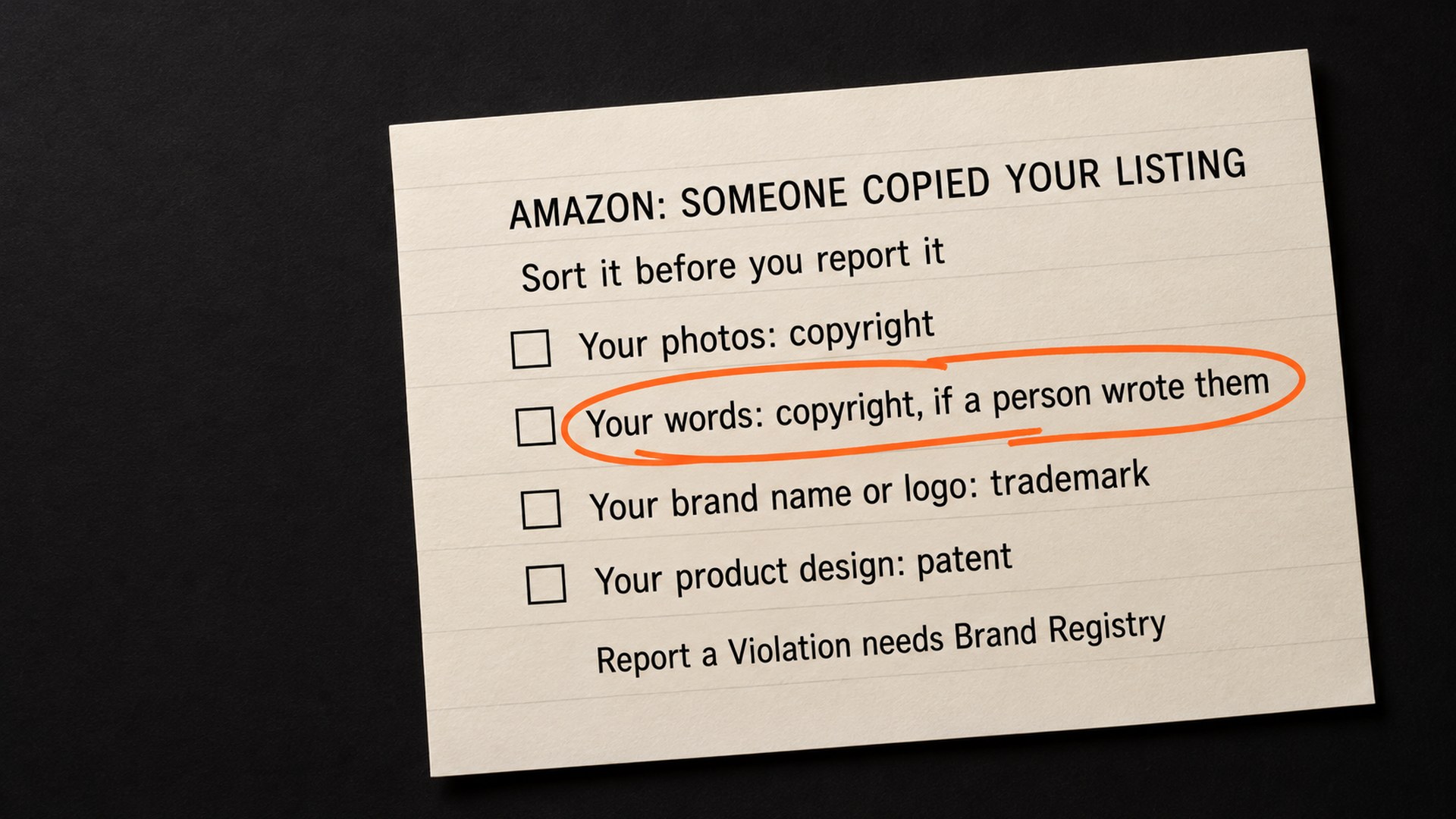
Why a copied listing is really three or four problems
Amazon's Intellectual Property Policy for US sellers names three main rights. Copyrights are "legal protections for original works of authorship". Trademarks protect the words, symbols and designs a company uses to identify its goods. Patents protect inventions.
A cloned listing can touch all three, and each part lands somewhere different:
- Your photographs: a copyright question. Amazon's own guide to reporting an IP violation gives someone using a photograph on their website without the owner's consent as an example of infringement.
- Your words: also copyright. The same guide lists someone "plagiarizing your written work to falsely claim it as their own". The catch is whether the words were authored by a person, which the next section covers.
- Your brand name or logo: a trademark question, when their listing carries branding that could be confused with yours.
- The product itself: a patent question, and only if you hold a patent. Amazon says its IP enforcement focuses on these three rights, so in our reading a similar product under the competitor's own brand is not, by itself, something those tools cover.
Sorting matters, in our view, because Amazon says its IP enforcement focuses on those three categories, so a report needs to say which right it rests on. The forum seller above had a registered brand but, in their words, no trademark on the text and no patent on the product. That left the photos and the words, and the words are where AI-written copy causes trouble.
Is AI-written Amazon listing copy protected by copyright?
Sometimes not, and the deciding question is how much of it a person wrote.
Thaler v. Perlmutter was about an image that Stephen Thaler's AI system generated, and JD Supra notes he listed the system as its sole author. The US Court of Appeals for the D.C. Circuit ruled in 2025 that copyright requires a human author. Thaler asked the Supreme Court to hear it, and the Supreme Court docket for Thaler v. Perlmutter, No. 25-449 records the result on 2 March 2026: "Petition DENIED." The Supreme Court did not rule on the question itself. As JD Supra's report on the denied review (third party) puts it, the denial leaves the 2025 D.C. Circuit opinion standing.
The US Copyright Office had already set out how it treats AI output, before the appeals court ruled, in its Copyright and Artificial Intelligence report, Part 2: Copyrightability, published in January 2025. Three of its conclusions matter for a listing:
- Purely generated text: "Copyright does not extend to purely AI-generated material, or material where there is insufficient human control over the expressive elements."
- Prompts: "Based on the functioning of current generally available technology, prompts do not alone provide sufficient control."
- Edits: "Human authors are entitled to copyright in their works of authorship that are perceptible in AI-generated outputs, as well as the creative selection, coordination, or arrangement of material in the outputs, or creative modifications of the outputs."
The Office adds that whether a person's contribution is enough "must be analyzed on a case-by-case basis." Nobody can tell you in advance that a particular edit crosses the line.
Put that against a listing. If you typed a prompt, accepted the bullets and published them, the words you want to defend may have no owner. Under that reading, a competitor who copies them may not be infringing anything. If you rewrote the draft, chose what stayed and reordered it around how your buyer actually decides, there is a person's work in it to point to. Your photos are a separate matter: a photograph somebody took of your real product is not generated text, so doubts about AI-written copy say nothing about those.
Competitor copied my Amazon listing: which kind of copy is it?
Open their listing and yours side by side, and go through it piece by piece rather than as a whole:
- Images: are they your actual photos, cropped or recoloured, or new photos of their own product styled like yours? Only the first is your photograph.
- Title and bullets: word for word, or the same ideas in different words? Amazon's example is plagiarism of written work. Shared structure and a similar sales angle are much harder to call copying.
- A+ content: check it separately, because it often holds the photographs and the longer writing.
- Brand: does their listing use your brand name or logo, or only something that looks like your style?
- The product: if it is genuinely your product sold as theirs, or a counterfeit of yours, that is a counterfeit and trademark matter, and our guide on a hijacked Amazon listing covers the different case where someone changes your own page.
Write down which pieces match and which merely resemble. That list is what every later step uses.
What to check first before you report a competitor
Three things decide whether a report has anything under it, and they are cheap to check.
- Your own originals: the photo files from the shoot, and the first version of your copy with its date. A report is a claim that the work is yours, and the original files are what show it.
- Who wrote your words: be honest about whether your bullets were drafted by a person, edited by one, or published straight from a tool. That tells you whether the words belong in the report or should be left out of it.
- Your Brand Registry status: Amazon's 31 July 2026 Report a Violation announcement says brands must be enrolled to use the tool. If yours is not, Amazon's guide says a rights owner "can submit violations through the Report Infringement form in Seller Central". Our guide to Amazon Brand Registry enrollment covers getting in.
If the honest answer to the second check is "a tool wrote it and nobody touched it", I would leave the words out of the report and lead with the photographs, if they were taken, because a report is a claim that the work is yours and the photographs are the piece you can show.
How a report about a copied listing gets filed
Amazon's announcement of 31 July 2026 says Report a Violation in Brand Registry now offers "a single, guided experience" for IP infringement, store policy and regulatory reports. Structured forms replace the old free-text boxes, and a Submission History tab tracks each report's status and outcome.
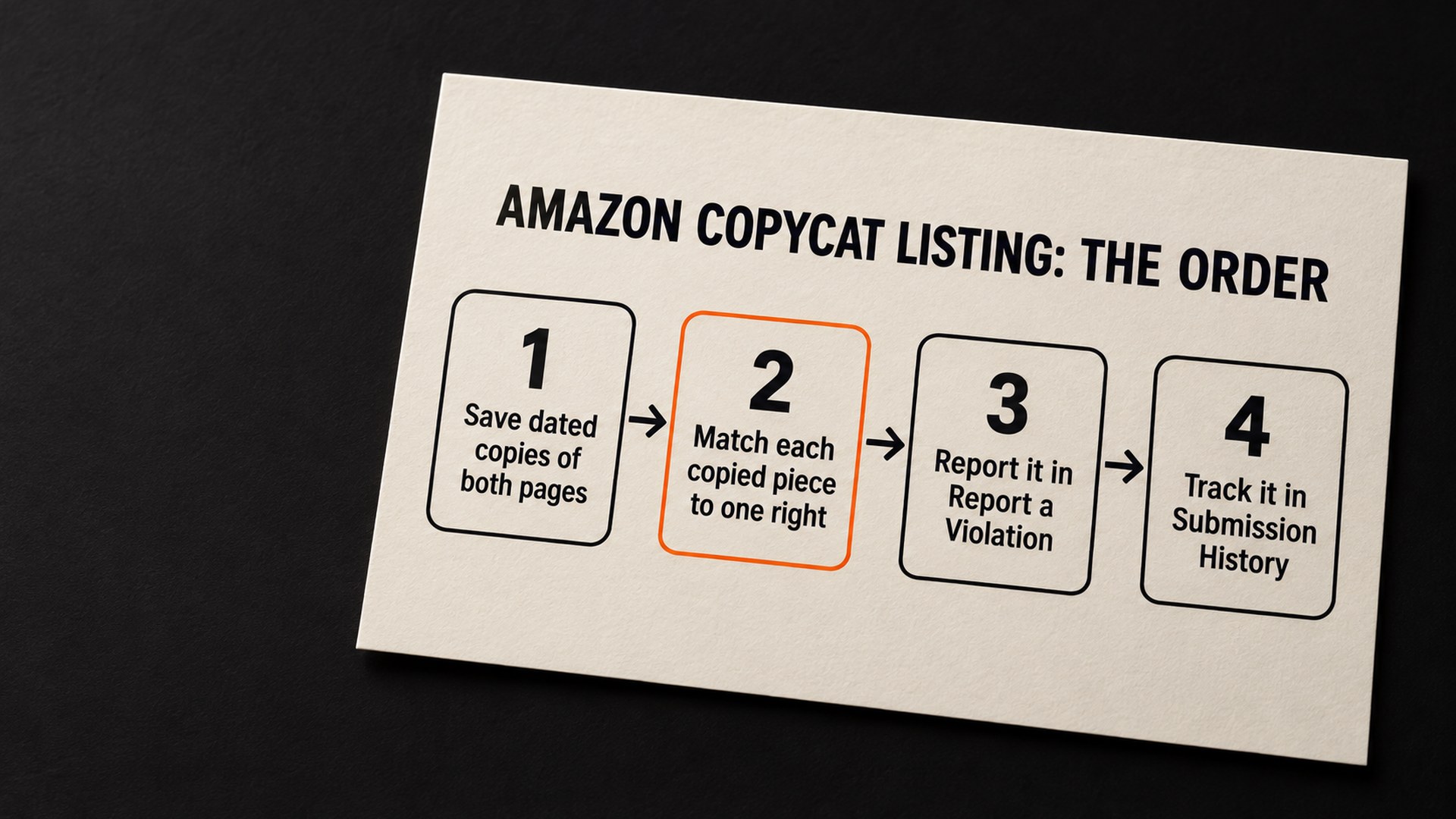
The order we work in is the one in the figure above:
- Capture both pages, dated: their listing and yours, before anything changes. A copy can be edited at any time, and a report about something no longer on the page is hard to support.
- Match each copied piece to one right: photos and written work to copyright, brand name or logo to trademark, a patented design to patent. One piece, one right.
- Report through the guided form: pick the right that fits each piece and attach what proves it is yours.
- Read the outcome in Submission History: if a report comes back rejected, the useful move is finding which claim failed and what it lacked, rather than sending the same report again.
Two cautions. A report is a statement that you hold the right, so only report what you can show is yours. And a competitor can report you too: Amazon's policy describes how a seller who receives a copyright notice they believe is wrong may file a counter-notice under the Digital Millennium Copyright Act. Our guide on answering an Amazon IP complaint covers that side.
Amazon's policy page is plain that it "is not legal advice", and it tells sellers to consult a lawyer about their specific IP rights. When the copying is extensive, or the money at stake is large, that is the right person to ask.
How to stop your next listing being free to copy
You cannot stop someone copying a page. What you can control is whether you have something to report when they do.
- Put a person's hand on the words: for your top listings, rewrite any AI draft so a person decided what it says and in what order. The Copyright Office's line is "creative modifications of the outputs", so the edit has to be real, not a few swapped words. Writing it around use cases, material and what the buyer worries about, rather than as a keyword list, is how we approach listing optimization anyway.
- Keep the record: save each version of the copy with its date, and keep the raw photo files from every shoot. If authorship ever has to be shown, the record is the evidence.
- Use your own photographs: Amazon's product image guide (US) asks that the main image "Accurately represent the product as a realistic, professional-quality image." Photos a person took of your real product, shot to those rules, are also work you can show is yours.
- Tag AI people: the same guide says images with photorealistic people entirely generated by AI must carry the contains-synthetic-performer tag before upload. Real people retouched with AI tools do not need it.
- Lock your own page: copying your listing onto a new one is a different problem from someone editing yours, and our guide to Amazon brand catalog lock covers protecting your own page.
A copied listing is annoying. A copied listing where you cannot show the work is yours is the expensive version, and that part is fixable before it happens.
Get a copied listing looked at before you file
This is the kind of work our team does: reading two listings side by side, sorting what can be reported from what cannot, and preparing reports with evidence attached. In listing hijacker cases we have removed unauthorised sellers with IP complaints backed by test-buy evidence; a copycat under its own brand is a different case, and we will tell you which one you have. We cannot promise a removal or a timeline, and where the question is really a legal one we will say so and point you to a lawyer. If a competitor has copied your listing, a free review of the copied listing tells you which parts look reportable and what evidence is missing.
Common questions about a copied Amazon listing
Can I report a competitor who copied my Amazon listing word for word
Only if you hold the copyright in the words. Amazon's own reporting guide lists plagiarising your written work as an example of copyright infringement, and enrolled brands report it through Report a Violation. The open question is whether a person authored the words, because purely AI-generated text is not protected under current US rules.
Is AI-generated Amazon listing copy copyrighted
Not if it is purely AI-generated. The US Copyright Office says copyright does not extend to purely AI-generated material, and that prompts alone do not give enough control. Creative changes a person makes to the output can be protected, and the Office says that is decided case by case.
What did the Supreme Court decide in Thaler v. Perlmutter
It declined to hear the case on 2 March 2026, so it did not rule on the question itself. That leaves the D.C. Circuit's 2025 ruling standing, that copyright requires a human author. The case concerned an image generated by an AI system that was listed as its author.
Can I report copied images without Brand Registry
Amazon says a rights owner without an enrolled brand can submit violations through the Report Infringement form in Seller Central. Report a Violation itself needs a brand enrolled in Brand Registry.
Can I report a competitor for selling a similar product on Amazon
In our reading, not through Amazon's IP tools on that basis alone. Amazon says its IP enforcement focuses on copyrights, trademarks and patents, so a similar product under the competitor's own brand is reportable there only if it infringes one of those, such as a patent you hold or your trademark.
Sources
- Competitor copied my listing, Amazon Seller Forums thread (US)sellercentral.amazon.com
- Intellectual Property Policy, Seller Central help (US)sellercentral.amazon.com
- How to report an IP violation to Amazon, Amazonsell.amazon.com
- Thaler v. Perlmutter, No. 25-449, Supreme Court docketsupremecourt.gov
- Supreme Court denies review in AI authorship case, JD Supra (third party)jdsupra.com
- Copyright and Artificial Intelligence, Part 2: Copyrightability, US Copyright Office (January 2025)copyright.gov
- Report brand violations faster with one guided experience, Amazon (31 July 2026)sell.amazon.com
- Product image guide, Seller Central help (US)sellercentral.amazon.com
Founder, AVA INC.
Shilpi Dudani is the founder of AVA INC. Her team manages Seller Central accounts, fixes catalog problems and optimizes listings for Amazon sellers.
Not sure whether this is your problem?
We will look at your account and tell you what is actually wrong before you spend anything.
Get your free, no-obligation audit