Amazon ECGT notice: clearing eco-friendly claims from your EU listings
Since 27 September 2026, generic green claims without recognised proof are banned in the EU. What Amazon's ECGT notice covers and how to clear EU listings.

- 12 min read
- Marketplace Expansion
Fact-checked against Amazon's own pages on 4 Oct 2026
On this page
The short answer
- The law behind the Amazon ECGT notice: from 27 September 2026, EU law prohibits generic environmental claims such as “eco-friendly” or “green” unless the product has recognised excellent environmental performance relevant to the claim, such as the EU Ecolabel.
- The Amazon ECGT notice: as reported by amalytix, it went to vendors first, flags claims in listing text in the EU stores, attaches an ASIN list that is not complete, and says affected offers can be deactivated. Sellers are covered by the same law, notice or not.
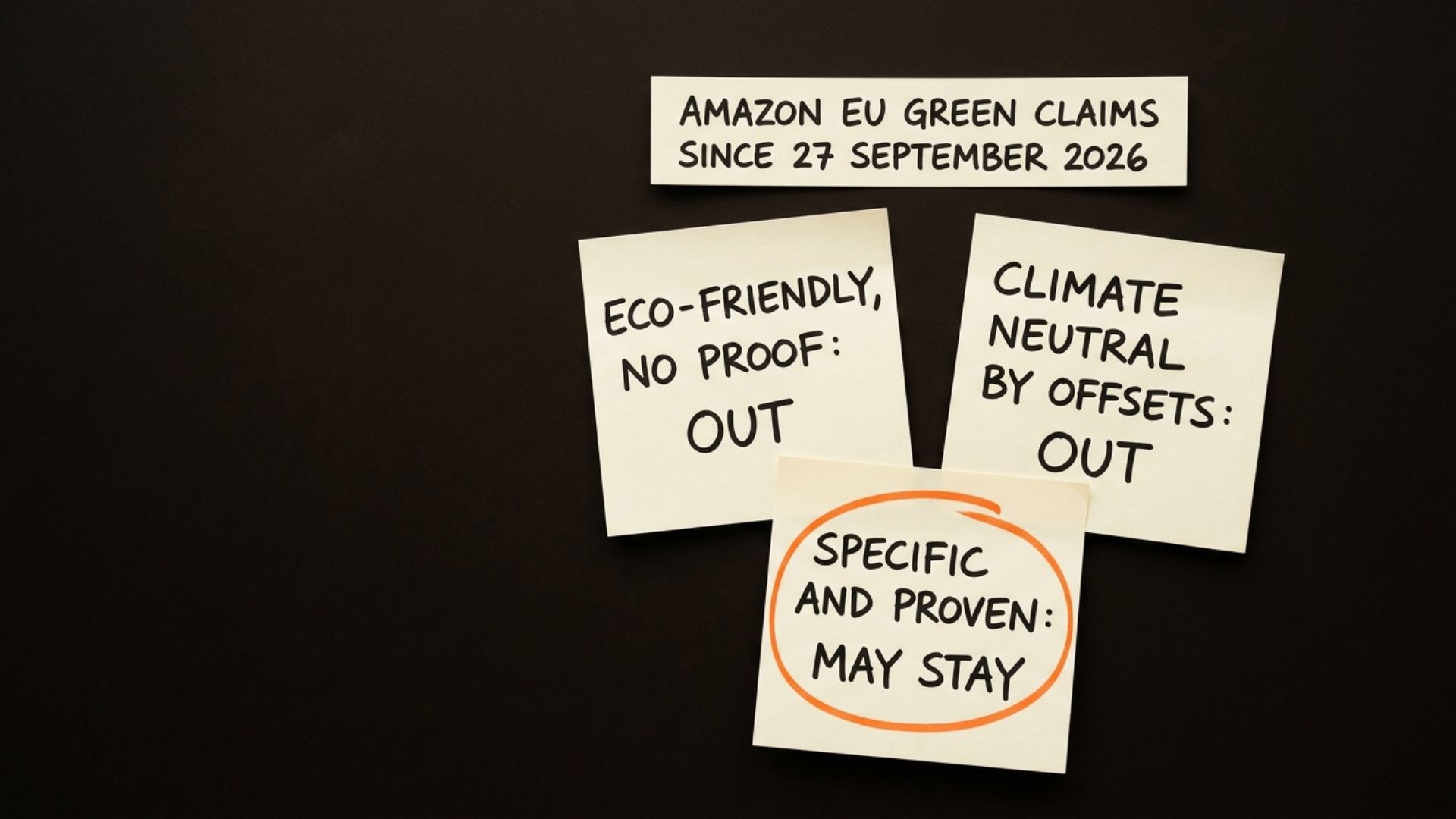
- Specific is different: a claim spelled out on the same page is not a generic claim. “Climate-friendly packaging” on its own is a generic claim, banned without recognised excellent environmental performance; a precise statement about the packaging is not caught by that ban, though it still has to be true and provable.
- Offsets are out: “climate neutral” for a product, based on offsetting outside its value chain, is prohibited.
- Look past the text: leaf badges, home-made seals, brand names and A+ modules can all carry a claim, so a sweep covers every surface in every EU language.
Since mid-August 2026, Amazon has been sending Action Required notices about something called the ECGT Directive, the Amazon ECGT notice in short, often with an Excel file of ASINs attached. That is how amalytix, an Amazon analytics company, described the notices on 21 August 2026. The first ones went to vendors in Vendor Central, and amalytix advises sellers to check their own compliance dashboard in Seller Central too, because the law covers everyone selling to consumers in the EU. The examples Amazon gave were words many listings use: eco-friendly, environmentally friendly, sustainable materials, climate-neutral, carbon-neutral.
The date in those notices was 27 September 2026. That is not a date Amazon picked. It is the day an EU law on green claims started to apply, and amalytix reported that offers with the flagged claims still live after it can be deactivated.
I understand how that lands if you are a US or UK brand that expanded into Germany two years ago. Nobody told you a word in your bullet points had become a legal question. The part that will actually annoy you is that the spreadsheet is the easy bit. The Amazon ECGT notice lists claims in your listing text, and the claims in your images, your A+ and your brand pages are still yours to find.
What the Amazon ECGT notice says, and what changed on 27 September
ECGT stands for Empowering Consumers for the Green Transition. It is Directive (EU) 2024/825, and it amends the EU’s unfair commercial practices rules. According to the European Commission’s page on sustainable consumption, member states had until 27 March 2026 to write it into national law, and it has applied since 27 September 2026.
amalytix reports that Amazon’s help page on this sits in Vendor Central, under Product compliance. It is behind a login, and we could not find a public version of it as of 4 October 2026, so what we know about the notice comes from the amalytix write-up. Their account of it:
- Where it appears: the compliance dashboard, as an Action Required notice, since mid-August 2026. The first notices went to Vendor Central; for sellers, amalytix points to Account Health and Product compliance in Seller Central.
- What is attached: often an Excel file of ASINs, which amalytix describes as covering claims in listing text and as non-exhaustive.
- What Amazon may do: first remove the section of the page that carries the claim, then deactivate offers where the claim is still live after 27 September 2026.
- Which stores: the work has to be done per EU marketplace. amalytix lists Germany, France, Italy, Spain, Poland, the Netherlands, Sweden, Belgium and Ireland.
This is EU law, aimed at consumers in the EU, so it governs Amazon’s EU stores. amazon.co.uk is governed by UK rules on green claims rather than this directive, and this post does not cover those.
Why eco-friendly became a problem on Amazon EU listings
The mechanism is one line in the law. The Commission’s questions and answers on the ECGT Directive, published in September 2026 as the preliminary views of the Commission’s services, quotes the new entry on the list of practices banned in all circumstances: “Making a generic environmental claim for which a trader is not able to demonstrate recognised excellent environmental performance relevant to the claim.”
Two definitions carry all the weight.
- Generic environmental claim: a written or spoken environmental claim that is not on a sustainability label and is not specified in clear and prominent terms on the same medium. The Commission’s examples include “environmentally friendly”, “eco-friendly”, “green”, “climate friendly”, “biodegradable” and “energy efficient”.
- Recognised excellent environmental performance: in practice, the EU Ecolabel, an officially recognised national or regional ecolabel such as the Nordic Swan or the Blue Angel, or top performance under other EU law, such as the energy label. It has to be relevant to the claim being made.
So the question is not whether your product is genuinely better for the environment. It may well be. The question is whether the claim on the page is vague, and whether you hold the specific kind of proof the law names. A product can be made with real care and still have no ecolabel, and for that product the word “eco-friendly” on its own is now the problem.
Three related rules catch sellers who thought they were being careful:
- Offsets: a claim that a product is climate neutral, reduced or positive because of offsetting outside its value chain is prohibited. A claim based on the product’s actual lifecycle emissions can still be made, with proper evidence.
- Home-made seals: a sustainability label may only be shown if it is based on a certification scheme or set up by a public authority. A leaf badge your designer drew does not qualify.
- Names: the Commission says brand and product names are not excluded. A name with “eco” or “green” in it is judged case by case, on whether it creates an environmental association for the average shopper.
There is no grace period for stock you already had. The Commission’s Q&A says the rules apply from 27 September 2026 to existing products and “old stock” as well.
How to know if your Amazon ECGT exposure goes beyond the notice
The notice is the obvious signal, but not the only one. These are the things worth checking, quickly, for every EU store you sell in:
- A notice in any EU store: vendors in Vendor Central, sellers in Account Health and Product compliance. The work is per marketplace, so a clean Germany says nothing about whether France was checked.
- Green words in your English source copy: if your EU listings were translated from a US listing that says “eco-friendly”, the translation almost certainly says it too.
- Badges and icons in your images: the Commission says a green leaf or a water drop next to sustainability text may be read as an environmental claim or as a sustainability label, depending on the context.
- A+ and Brand Story modules: these are written once and rarely revisited, which makes them an easy place for an old claim to survive.
- Carbon neutral messaging: if any of it rests on offsets bought for the product, it is in scope.
What to check first: the ASIN list is not the whole catalogue
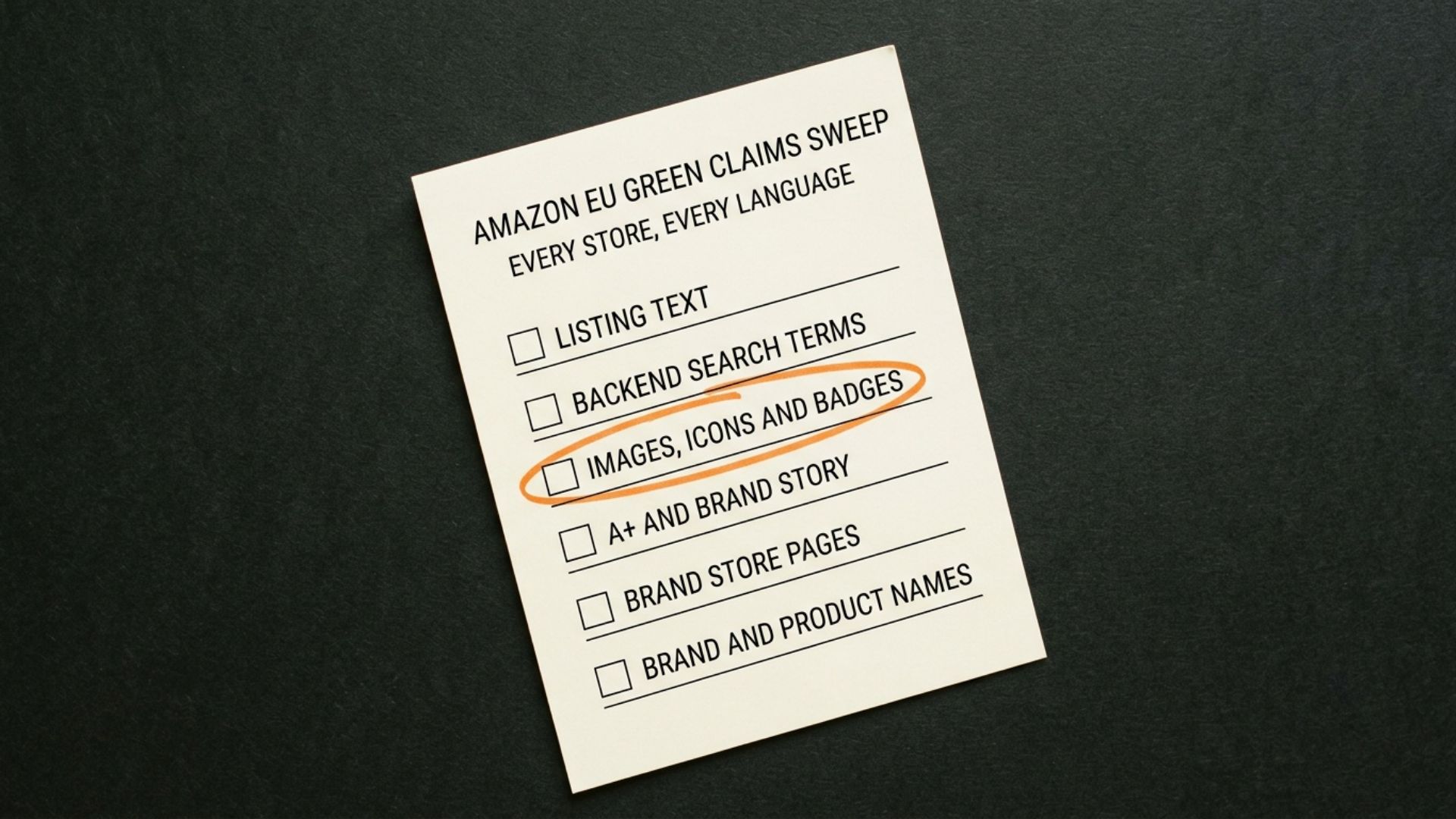
If I had one afternoon and a German catalogue, this is the order I would work in. It goes from the places Amazon is already reading to the places nobody has opened in a year.
- The notice and its file, in every EU store: download each one. Treat the ASIN list as a starting point, because amalytix describes it as covering listing text only.
- Listing text, in the store’s language: title, bullets, description and backend search terms. In German the words to look for include umweltfreundlich, nachhaltig and klimaneutral, which the German retailers’ association Haendlerbund named on 24 September 2026. Each language needs its own search.
- Images: main and secondary images and infographics, looking for both words and badges. This is the one that catches people out, because nobody reads their own images as text.
- A+ and Brand Story: every module, in every language version. Our guide to A+ content covers where those modules live.
- Brand Store pages and names: store tiles, and any brand or product name with a green word in it. A name is a bigger decision than a bullet, so it is worth looking at early even if it is fixed last.
Amazon’s notice, as reported, is about detail pages. Whether Amazon checks Store pages the same way, we do not know. The law, though, covers commercial communication to consumers in any form, so we would not leave a Store tile saying “sustainable” on the theory that nobody is reading it.
How Amazon ECGT environmental claims get fixed
Every flagged claim ends up on one of three paths. Choosing the path claim by claim, rather than deleting every green word in a panic, keeps whatever is genuinely true and worth saying.
- Remove it: for vague words with nothing behind them. “Eco-friendly”, “green”, “sustainable” on their own. This is the fastest path, and often the only realistic one for a reseller.
- Specify it: say exactly what is true, on the same page. The Commission contrasts “climate-friendly packaging” (generic) with “100% of energy used to produce this packaging comes from renewable sources” (specific). A specific claim still has to be true and provable, and the Commission’s Q&A says the specification belongs on the same medium, which it says includes the online selling interface.
- Prove it: the Commission says a generic claim such as “eco-friendly” can be used on a product awarded the EU Ecolabel or an officially recognised national ecolabel, with exceptions: the Commission excludes labelled mixtures such as detergents, cosmetics and paints, and amalytix advises, as its own reading, that “sustainable” should not rest on an ecolabel alone. For claims Amazon treats as allowed if substantiated, amalytix reports that the evidence is uploaded through compliance media per marketplace, and that resellers are expected to get those documents from their supplier.
If offers have already been deactivated, the order matters. Fix every surface for that ASIN first, in every language, and keep a note of what changed. Then, in our approach, raise it through the notice in the compliance dashboard, or with support if the notice gives no route. We could not find any Amazon page describing how reactivation works for these notices, so we cannot tell you how long it takes, and we would be wary of anyone who says they can.
One more thing to look at before you call it done: where the copy came from. If a feed tool, a flat file built from your US template or a listing translation service pushes your English source copy into the EU stores, the claim can come back the next time it runs. That is the same pattern behind listing changes that keep reverting, and the fix is to change the source, not just the page.
How to stop green claims coming back
- Clean the source copy: remove generic claims from the master listing you translate from, even for the US, so new EU listings start clean.
- Brief your designer: no home-made seals, and no leaf or globe icons next to sustainability text, on any image that might reach an EU store.
- Keep a dated change log per store: what was removed, rewritten or proved, and when. In Germany, Haendlerbund notes that competitors and consumer protection associations can send an Abmahnung, a formal warning letter, over these claims. A log does not prevent one, but it is the record you will want to have.
- Treat it like the other EU rules: ECGT now sits beside GPSR and EPR and LUCID as a reason an EU listing can be blocked while the US one carries on untouched.
Get your EU catalogue swept before the next notice
The honest summary is that the notice tells you where Amazon has already looked, and the law covers more than that. The work is finding every claim, in every store and every language, and deciding claim by claim whether it goes, gets specified or gets proved.
That is catalogue work our marketplace expansion team does for brands selling into Europe: reading the notices in each store, sweeping text, images, A+ and brand pages, and setting up the source copy so the claims do not quietly return. We are not lawyers, and we will say so when a claim needs one. We also cannot promise how Amazon will handle a reactivation. Get in touch and we will go through your EU listings with you.
Common questions about the Amazon ECGT notice
What is the ECGT Directive on Amazon?
ECGT is Directive (EU) 2024/825, Empowering Consumers for the Green Transition. It has applied since 27 September 2026 and bans generic environmental claims, such as eco-friendly or green, unless the trader can show recognised excellent environmental performance relevant to the claim. amalytix reported in August 2026 that Amazon has been sending notices about claims on detail pages in its EU stores, first to vendors in Vendor Central, and that sellers should check their compliance dashboard in Seller Central too.
Can I still say eco-friendly on Amazon Germany?
Only if the product has recognised excellent environmental performance relevant to the claim, which in practice means something like the EU Ecolabel or an officially recognised ecolabel such as the Blue Angel. Without that, the European Commission treats eco-friendly as a prohibited generic claim. A specific statement spelled out on the same page is not caught by that ban, though it still has to be true, provable and not misleading.
Does the ECGT rule apply to amazon.co.uk?
Not as UK law. The directive covers commercial practices aimed at consumers in the EU, so it governs Amazon's EU stores. The UK has its own rules on green claims, which are a separate question and are not covered here.
Is the ASIN list in Amazon's ECGT notice complete?
amalytix, which reported on the notices, describes the ASIN list as covering claims in listing text and as non-exhaustive. Images, infographics, badges and A+ Content need a separate check in each EU marketplace and each language.
Can I keep a carbon neutral claim on my Amazon EU listing?
Not if it rests on offsetting emissions outside the product's value chain: that is prohibited from 27 September 2026. The European Commission says a claim based on the product's actual lifecycle emissions can still be made if it is specified clearly on the same medium and properly substantiated.
Sources
- ECGT and Amazon listings, amalytix (third party, 21 August 2026)amalytix.com
- Questions and answers on the ECGT Directive, European Commission (September 2026)commission.europa.eu
- Sustainable consumption, European Commissioncommission.europa.eu
- Directive (EU) 2024/825, EUR-Lexeur-lex.europa.eu
- Klimaneutral, nachhaltig: liability from 27 September, Haendlerbund (third party, 24 September 2026)haendlerbund.de
Founder, AVA INC.
Shilpi Dudani is the founder of AVA INC. Her team manages Seller Central accounts, fixes catalog problems and optimizes listings for Amazon sellers.
Not sure whether this is your problem?
We will look at your account and tell you what is actually wrong before you spend anything.
Get your free, no-obligation audit