Amazon Europe FBA fees in 2026: the cut, the surcharge and the peak
Amazon cut European fees for 2026, then added a 1.5% surcharge, a revised digital services fee and peak rates. What changed, and how to model it per SKU.

- 12 min read
- FBA & Operations
Fact-checked against Amazon's own pages on 2 Oct 2026
On this page
The short answer
- The cut was real: Amazon lowered European fees by an average of £0.15/€0.17 per unit sold for 2026, through parcel fulfilment fees, referral fees in five category groups and a wider Low-Price FBA band.
- So were the increases: the same announcement raised storage, return-to-seller and liquidation fees and changed fulfilment fees in five smaller stores, which Amazon put at an average £0.02/€0.02 per unit sold via FBA.
- Two charges came later: a 1.5% fuel and logistics surcharge on fulfilment fees from 17 April 2026, and a revised digital services fee from 20 March 2026 that depends on where you are established.
- Peak is next: festive peak fulfilment fees apply from 15 October 2026 to 14 January 2027 in the UK and Germany and on cross-border fulfilment through the European Fulfilment Network and Remote Fulfilment, and the surcharge is calculated on the fulfilment fee.
- Neither average is yours: the honest number comes from rebuilding each SKU in Amazon's own fee tools, because category, price, size tier and where you are established all change the answer.
"Hello, until when will the surcharge take effect?" A seller left that question under Amazon's announcement of the European fuel and logistics surcharge, adding that fuel prices in Germany had almost come back to where they were. It is a fair question. Amazon's announcement describes it as a temporary surcharge and gives no end date.
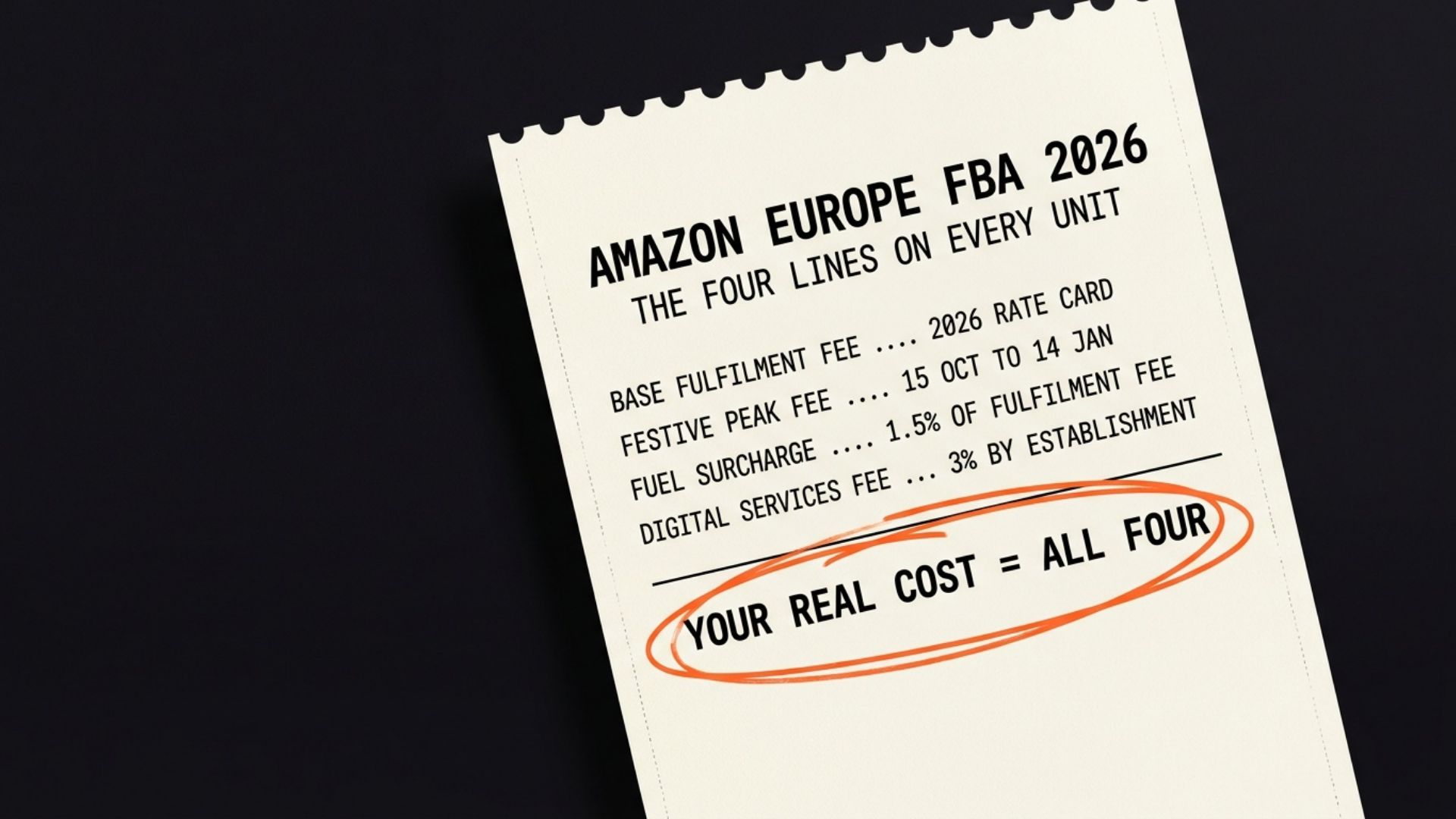
That surcharge is one of four things that have moved Amazon Europe FBA fees in 2026, and only one of them came with a headline. In December 2025 Amazon announced one of its largest-ever European fee reductions. Since then a fuel surcharge arrived in April, the digital services fee changed in March, and the festive peak fee starts again on 15 October 2026.
I understand why the December headline is the part that stuck. A fee cut feels like news you can file. The trouble is that the cost model built on it in January is now three layers out of date, and the cheapest moment to rebuild it is before peak rather than after.
What changed in Amazon Europe FBA fees for 2026
The starting point is Amazon's update to European referral and FBA fees for 2026, published on 2 December 2025. It came in two waves.
From 15 December 2025, FBA fulfilment fees for parcels fell by an average of £0.26/€0.32 in the UK, Germany, France, Italy and Spain stores. Referral fees for Clothing and Accessories dropped from 8% to 5% for items up to £15/€15, and from 15% to 10% between £15/€15 and £20/€20.
From 5 January 2026, in all European stores, the second wave landed. (The rate card separately dates its non-parcel fulfilment fee changes to 1 February 2026.)
- Home Products: referral fees from 15% to 8% for items up to £20/€20.
- Pet Clothing and Food: from 15% to 5% for items up to £10/€10.
- Grocery and Gourmet, and Vitamins, Minerals and Supplements: from 8% to 5% for items up to £10/€10.
- Low-Price FBA: extended in most categories to products priced at or below £20/€20, lowering FBA fees for newly eligible products by an average of £0.40/€0.45 per unit.
- Deals: caps on variable fees for Best Deals and Lightning Deals lowered to £200 in the UK, €300 in Germany and €100 in France, Italy and Spain.
Then comes the paragraph that is easiest to skim past. "Finally, we will make selective fee increases to optimize the efficiency of our network, including to monthly storage fees, return-to-seller, and liquidation fees, and will update FBA fulfillment fees in our Netherlands, Sweden, Belgium, Ireland, and Poland stores." The next sentence reads: "Together, these updates will result in an average £0.02/€0.02 increase in fee per unit sold via FBA."
Why a fee cut and a fee increase can both be true
It is tempting to read the £0.02 as proof that the whole cut was really an increase. The announcement does not say that. The £0.02 sits in the paragraph about the increases, and the £0.15 is Amazon's headline figure for the reductions. They are two averages over two different baskets, and the announcement does not say whether either one already nets off the other.
Which one describes you depends on what you sell. A €15 clothing item sold in Germany picked up a lower referral fee and may now qualify for Low-Price FBA. A slow-moving item stored for months, or a product selling in the Netherlands or Poland stores, mostly met the increases. Amazon said as much in its own words: "As we reduce fees where costs have decreased, we are also making targeted adjustments to optimise fulfilment network efficiency and ensure capacity is available for fast-moving and healthy selection."
That sentence is the whole design in one line. Broadly, fast, light, low-priced selection got cheaper, and stock that sits or comes back got dearer. An average across both tells you very little about either.
The three charges that arrived after the headline
The 1.5% fuel and logistics surcharge
From 17 April 2026, Amazon applies a 1.5% fuel and logistics-related surcharge to FBA fulfilment fees in the UK, France, Germany, Italy, Spain, Poland, Sweden, the Netherlands, Ireland and Belgium. Multi-Channel Fulfilment followed on 2 May 2026 in the UK, France, Germany, Italy and Spain.
Two details matter for the model. The surcharge "will be calculated on your fulfilment fees, not on the sale price of your items", so it grows with the size tier, not with your price. And Amazon's own average, £0.05/€0.05 per unit for EU FBA, comes with the caveat that it "will vary based on your item's size and dimensions." Amazon says it "will continue to evaluate this surcharge as conditions evolve." As of 2 October 2026 we have found no announcement ending it, so it is safer in the model as a running cost than as a footnote.
The digital services fee from 20 March 2026
Amazon's digital services fee update changed how the fee applies in the France, Italy and Spain stores for sellers established outside those countries. It is a percentage added to your Amazon fees, and which fees it touches depends on where your business is established:
- Established in the UK: 3% on Selling on Amazon and FBA fees for sales in the France, Italy and Spain stores.
- Established in Italy or Spain: 3% on Selling on Amazon and FBA fees for sales in the UK and France stores.
- Established anywhere else, including the US: 3% on Selling on Amazon fees in the Italy, Spain and France stores, and 3% on FBA fees in the France store.
This is the layer that splits sellers by paperwork rather than product. Two businesses selling the same product into Italy or Spain can carry different fee lines: a UK-established seller pays the 3% on both Selling on Amazon and FBA fees there, while a seller established in the US pays it on Selling on Amazon fees only.
The festive peak fee from 15 October 2026
The FBA rate card for Europe, effective 1 July 2026, says the festive peak fulfilment fee for FBA, excluding apparel, applies from 15 October 2026 through 14 January 2027. On 15 January 2027 fees go back to the non-peak rates, which Amazon says are unchanged from the 2026 non-peak rates.
It would be easy to read “excluding apparel” as “no peak for clothing”, and that would be a mistake. The same rate card carries a separate peak table for parcel-size products in selected categories, a list that includes Clothing and Accessories, Footwear, Grocery and Gourmet, and Pet Clothing and Food, and those rates rise at peak too. It is worth finding your category's table rather than relying on the headline line.
The peak tables set rates for the UK and Germany, and for cross-border fulfilment through the European Fulfilment Network, including between EU stores, and Remote Fulfilment between the UK and the EU. Reading the UK and Germany table row by row, every parcel row goes up, the larger UK envelopes rise a little, and the oversize rows and the lightest envelopes carry the same figure in both columns. The Low-Price FBA section of the rate card has no peak table at all.
How to know if the 2026 changes raised your costs
A few patterns tell you the December headline probably did not describe your account:
- Slow stock: inventory that sits for months meets the storage increases, which the cuts did not touch.
- Smaller stores: sales in the Netherlands, Sweden, Belgium, Ireland or Poland stores, where Amazon said it would update fulfilment fees. Fulfilment fees follow the store where the item is sold.
- Cross-border sales into France, Italy or Spain: the digital services fee depends on where you are established, not on the product.
- Removals: return-to-seller and liquidation were both on the increases list.
- Parcels sold in the UK or Germany, or fulfilled cross-border, in Q4: every parcel row in the peak tables rises.
The more of those describe you, the more optimistic the January model is likely to be. That is not a disaster. It just means the margin you priced against is not quite the margin you have.
What to check first
The order matters, because each input decides the next one.
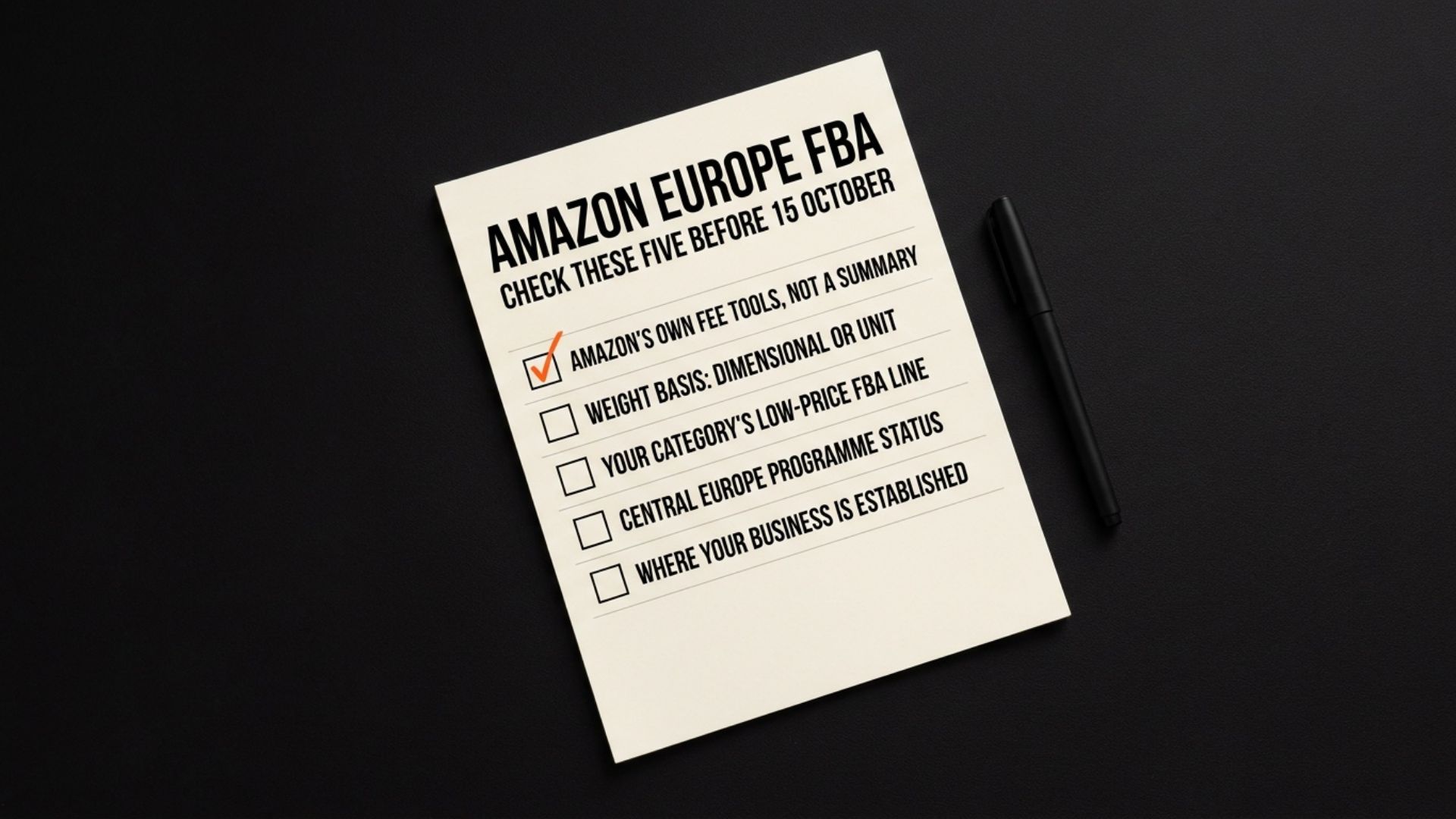
- Amazon's own fee tools, not a summary: Amazon says the Revenue Calculator, the Fee and Economics Preview report and Profit Analytics carry the 2026 rates and the surcharge, and the digital services fee shows in the Revenue Calculator. A blog's table, including ours, is a second-hand copy.
- Weight basis: the rate card uses the greater of dimensional and unit weight for most parcels and oversize items, and unit weight for envelopes, Low-Price FBA and special oversize. The wrong basis puts a SKU in the wrong tier before any other number is touched.
- The Low-Price FBA line: it is £20/€20 including VAT in most categories, but the rate card sets a lower limit, £10 in the UK and €11 or €12 in the euro stores, for Beauty, Health and Personal Care, Grocery and Gourmet, Kitchen, Books, Office Products and a few others. That exception is the easiest one to miss, because the December announcement only says “most categories”.
- Central Europe Programme status: if you hold FBA stock in Germany and are not in the programme, the rate card adds £0.26/€0.26 per unit shipped from German fulfilment centres.
- Where your business is established: that single fact decides your digital services fee lines.
How the per-SKU model gets built
The sum itself is simple once the inputs are right. Here is one size tier straight from the rate card, a small parcel up to 400 g, sold in the UK and in Germany under the Central Europe Programme (CEP). Peak runs 15 October to 14 January, and the last row adds the 1.5% surcharge to the peak fee, rounded to the penny or cent:
| Up to 400 g | UK | Germany (CEP) |
|---|---|---|
| Non-peak | £3.00 | €3.13 |
| Peak | £3.11 | €3.34 |
| Peak plus 1.5% | £3.16 | €3.39 |
Those fees come from Amazon's rate card effective 1 July 2026. The last column is our arithmetic: Amazon calculates the surcharge on the fulfilment fee, so we apply it to the peak fee too. Eleven pence or twenty-one cents a unit looks small on one line. Across a whole peak season of volume it can be the difference between a deal that pays and one that only moves units.
From there the model adds the referral fee at your price band, the digital services fee where your establishment triggers it, storage at your real sell-through, and removals if you use them. Then it compares the result to the price you plan to run in Q4, including any deal. Done per SKU, it can show some products moving one way and some the other, which is exactly what the two averages hide.
If the money question is US fees too, our guide to Amazon FBA fee changes in 2026 covers the US side, and our three-margin pricing framework shows what to do with a SKU once the model says its margin has slipped.
How to stop fee changes catching you out again
- Read the whole announcement: the December letter put its increases in a paragraph that begins “Finally”, after the cuts.
- Keep surcharges on their own line: a separate line for the fuel surcharge and the digital services fee means one edit when Amazon changes either, rather than a rebuild.
- Re-run the model before each peak: the peak tables are separate from the non-peak ones, so a model built on non-peak rates is out by design for three months of the year.
- Treat expansion as a fee decision too: every new store adds its own fee lines, which our guide to expanding from the US to the UK, EU and Canada walks through, alongside compliance rules such as EPR and LUCID in Germany and France.
- Reconcile what Amazon charged: what matters is what was actually deducted per unit, and our guide to FBA shipment reconciliation covers where money goes missing.
Get your European fee model checked before 15 October
The question underneath all of this is plain: which of your SKUs are still profitable at peak rates, with the surcharge and the digital services fee included. That is worth knowing before the deals go in, not after the January statement.
Our marketplace expansion team works on UK and EU accounts, and we can audit what you are actually paying there: reading your fee preview against the rate card, looking for SKUs on the wrong side of the Low-Price line or in the wrong size tier, and showing you where the margin went. We cannot promise what Amazon will charge next year, and we will not guess at it either. Get in touch and we will go through your European catalogue with you.
Common questions about Amazon Europe FBA fees in 2026
Did Amazon lower or raise European fees for 2026?
Both, in the same announcement. Amazon said fees would fall by an average of £0.15/€0.17 per unit sold across Europe, and in the same update it raised storage, return-to-seller and liquidation fees and changed fulfilment fees in the Netherlands, Sweden, Belgium, Ireland and Poland, which it put at an average £0.02/€0.02 increase per unit sold via FBA. Which one describes you depends on your catalogue.
Is the 1.5% fuel surcharge charged on my selling price?
No. Amazon says the surcharge is calculated on your fulfilment fees, not on the sale price of your items. It has applied to FBA in the UK, France, Germany, Italy, Spain, Poland, Sweden, the Netherlands, Ireland and Belgium since 17 April 2026.
When does the Amazon Europe peak fulfilment fee apply?
Amazon's rate card says the festive peak fulfilment fee for FBA, excluding apparel, applies from 15 October 2026 through 14 January 2027, with peak rates for the UK and Germany and for cross-border fulfilment through the European Fulfilment Network and Remote Fulfilment. A separate peak table covers parcel-size products in selected categories, including clothing. Fees revert to the non-peak rates on 15 January 2027, and since Amazon calculates the 1.5% surcharge on the fulfilment fee, on our reading it applies to the peak fee too.
What is the Low-Price FBA price limit in Europe in 2026?
Amazon extended Low-Price FBA in most categories to products priced at or below £20/€20 in early 2026. The rate card sets a lower limit, £10 in the UK and €11 or €12 in the euro stores, for categories including Beauty, Health and Personal Care, Grocery and Gourmet, Kitchen and Books. Prices include VAT.
Does the digital services fee apply to US sellers selling into Europe?
Yes, partly. From 20 March 2026, sellers established outside the UK, France, Italy and Spain pay a 3% digital services fee on Selling on Amazon fees in the Italy, Spain and France stores, plus 3% on FBA fees in the France store. UK-established sellers pay 3% on both fee types in France, Italy and Spain. The Revenue Calculator shows it.
Sources
- Fuel and logistics-related surcharge announcement, Amazon EU seller forumssellercentral-europe.amazon.com
- FBA rate card Europe, effective 1 July 2026 (Amazon)m.media-amazon.com
- Update to the digital services fee from 20 March 2026, Amazon EU seller forumssellercentral-europe.amazon.com
- Update to European referral and FBA fees for 2026, About Amazon EUaboutamazon.eu
Founder, AVA INC.
Shilpi Dudani is the founder of AVA INC. Her team manages Seller Central accounts, fixes catalog problems and optimizes listings for Amazon sellers.
Not sure whether this is your problem?
We will look at your account and tell you what is actually wrong before you spend anything.
Get your free, no-obligation audit