Amazon pending orders locking your UK stock: what sellers can do
Amazon pending orders can lock your stock for up to 21 days, and UK sellers have seen waves since 20 September 2026. What to check and what you control.

- 11 min read
- FBA & Operations
Fact-checked against Amazon's own pages on 5 Oct 2026
On this page
The short answer
- What pending means: Amazon is still verifying the buyer’s payment, and its own help page says that can, in some cases, stretch to 21 days.
- Why it hurts: the units come off your available quantity while the order is pending, and a seller cannot cancel a pending order.
- The UK wave: since 20 September 2026 some UK sellers report bursts of pending orders on high-priced items. Some sellers suspect rivals; The Register says there is no evidence yet that the activity is malicious rather than an Amazon glitch.
- Check the ordinary causes first: Amazon lists several innocent reasons for pending, including business orders waiting for approval.
- What a seller controls: reporting the pattern with order IDs, a Seller Support case, a maximum order quantity on the targeted listing, and a clear daily record. All of it is mitigation, not a cure.
On 25 September 2026, The Register reported that sellers on Amazon UK had been watching their stock disappear into pending orders that are not clearing. One seller had 30 pending orders in about 52 hours, and another 72 pending orders worth about 25,000 pounds in three days, according to The Register’s report. The reports started on 20 September, often on products priced at 100 pounds or more.
Amazon pending orders are normally a small, boring part of selling. A card fails, Amazon checks it, the order clears or it does not. The trouble is what happens to your stock in the meantime: Amazon takes the units out of what you can sell, and you cannot cancel the order yourself.
I understand how that feels when it is your best product, in the run-up to Black Friday. Your listing shows a sale. Your inventory shows nothing. And the answer from Amazon is a clock you do not control.
Why Amazon pending orders lock your stock
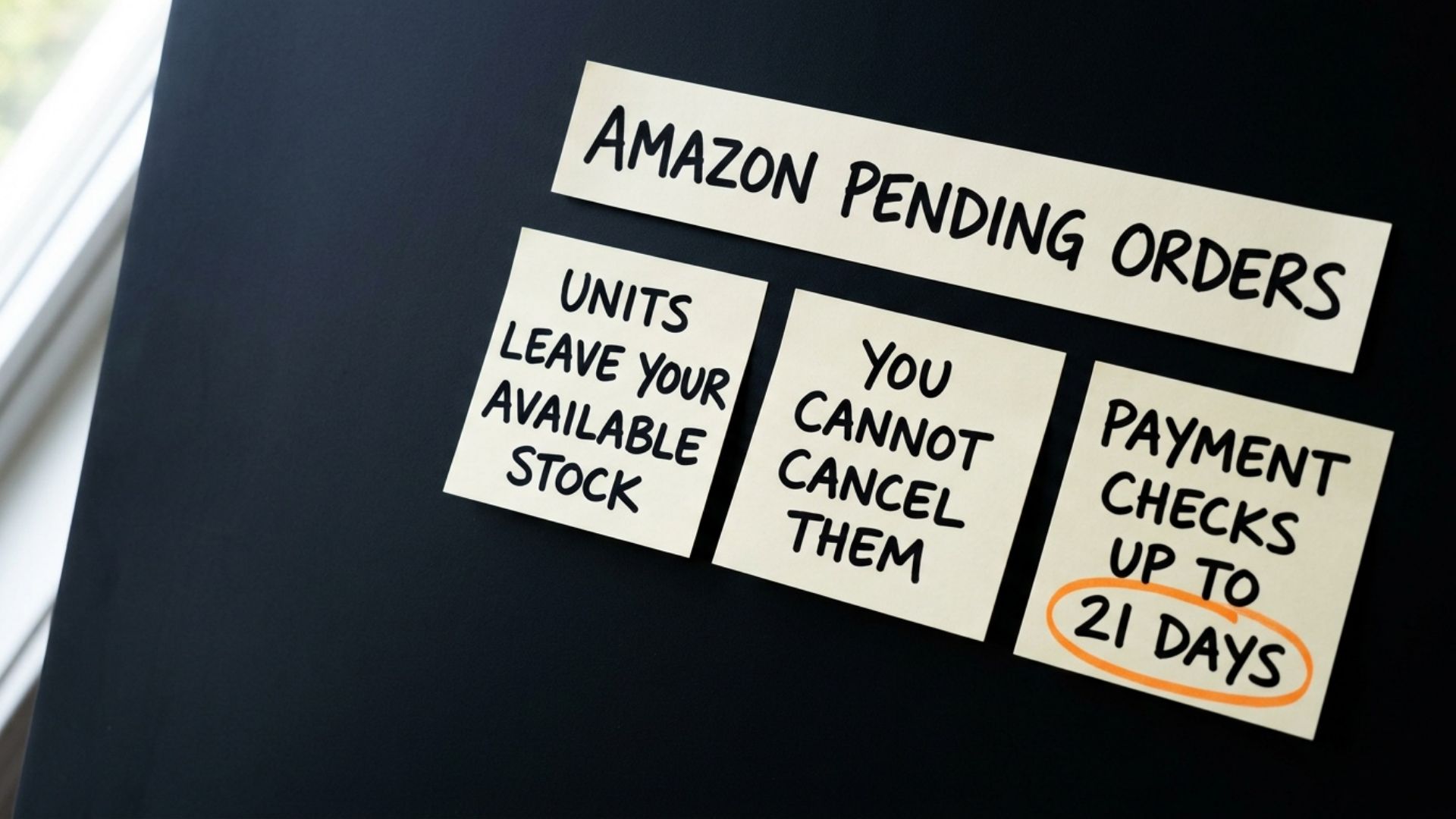
Amazon’s Pending Orders help page for the UK store says an order with a status of Pending “might indicate an issue with the buyer’s payment method.” It adds that, in some cases, its payment and order detail verification “can potentially extend order processing times by as much as 21 days.” The US version of the same help page gives the same 21 day figure.
The part that matters for your stock is in the same page: “The quantity available for the listing is subtracted from your quantity in Manage Inventory.” If you had one unit left, Amazon says the listing comes off the offer page and shows a quantity of zero while the order is processed.
Then the question every seller asks: can I cancel it? Amazon’s answer is one word, “No.” The Confirm shipment and Cancel order buttons only appear once the payment method has been verified.
So a pending order is a reservation with no deposit. That is fine when it is one buyer whose card needs a second try. It is a very different thing when dozens arrive on the same product in two days.
What happens at the end of the window comes from Amazon’s forum moderators rather than the help page. Cooper_Amazon, replying on the Seller Forums, wrote: “Generally pending orders can take up to 21 days to process. If they fall through the order is canceled and the product is released back into inventory.”
What happened on Amazon UK in September 2026
Both The Register and Shopifreaks, in its 27 September 2026 write-up, describe the same picture: reports from 20 September 2026, high-value items, and pending orders that do not clear. The Register adds that some sellers saw double or triple their usual weekly order volume.
Some sellers suspect competitors are ordering with cards that do not have the funds, to take stock off the shelf. The Register is careful here, and so should we be: it says there is no evidence yet that the activity is malicious rather than an Amazon glitch.
After The Register contacted Amazon, a forum message said the issue had been escalated to Amazon’s “partner teams” for investigation. Shopifreaks reports that Seller Support had first called the activity normal. As of 5 October 2026 we could not find a public statement from Amazon on what caused the September wave, so treat anything you read about a fix as unconfirmed.
The pattern itself is not new. Sellers on Amazon’s forums described the same thing two years ago, on the Pending Payment Scam Orders thread on Amazon’s Seller Forums among others. What is new is the timing. A locked best seller in October costs more than a locked best seller in February.
How to know if this is your problem
Pending on its own proves nothing. Amazon’s help page lists ordinary reasons an order sits in Pending, and some of them look alarming if you do not know them:
- Card authorisation: Amazon has not yet been able to authorise the buyer’s card.
- FBA orders waiting on other items: a free-shipping order waiting for all its items, or a multi-item order where one item is out of stock.
- Subscribe & Save: these orders are placed several days before the delivery date.
- Amazon Business: orders to commercial addresses can stay pending to match business hours, and business orders awaiting the customer’s approval can take up to seven days, or up to 14 days for Business Prime Medium and Enterprise customers, before Amazon cancels them.
The business one is the reason that surprises people. A burst of business orders can look like an attack when part of the explanation may be an approval window. In one 78 Fake Orders thread on Amazon’s Seller Forums, other sellers suggested a freight forwarder or a drop shipper as an innocent explanation for that shape of order.
What makes it look like the September pattern is the combination: many pending orders, on one ASIN or a few high-priced ones, arriving close together, far above your normal volume, and none of them clearing. Amazon’s help page says pending orders do not include the buyer’s shipping address or contact details, although one seller in the September wave said 15 of their 30 pending orders were linked to just seven delivery postcodes, according to The Register. Treat any delivery detail you can see as a clue, not a requirement.
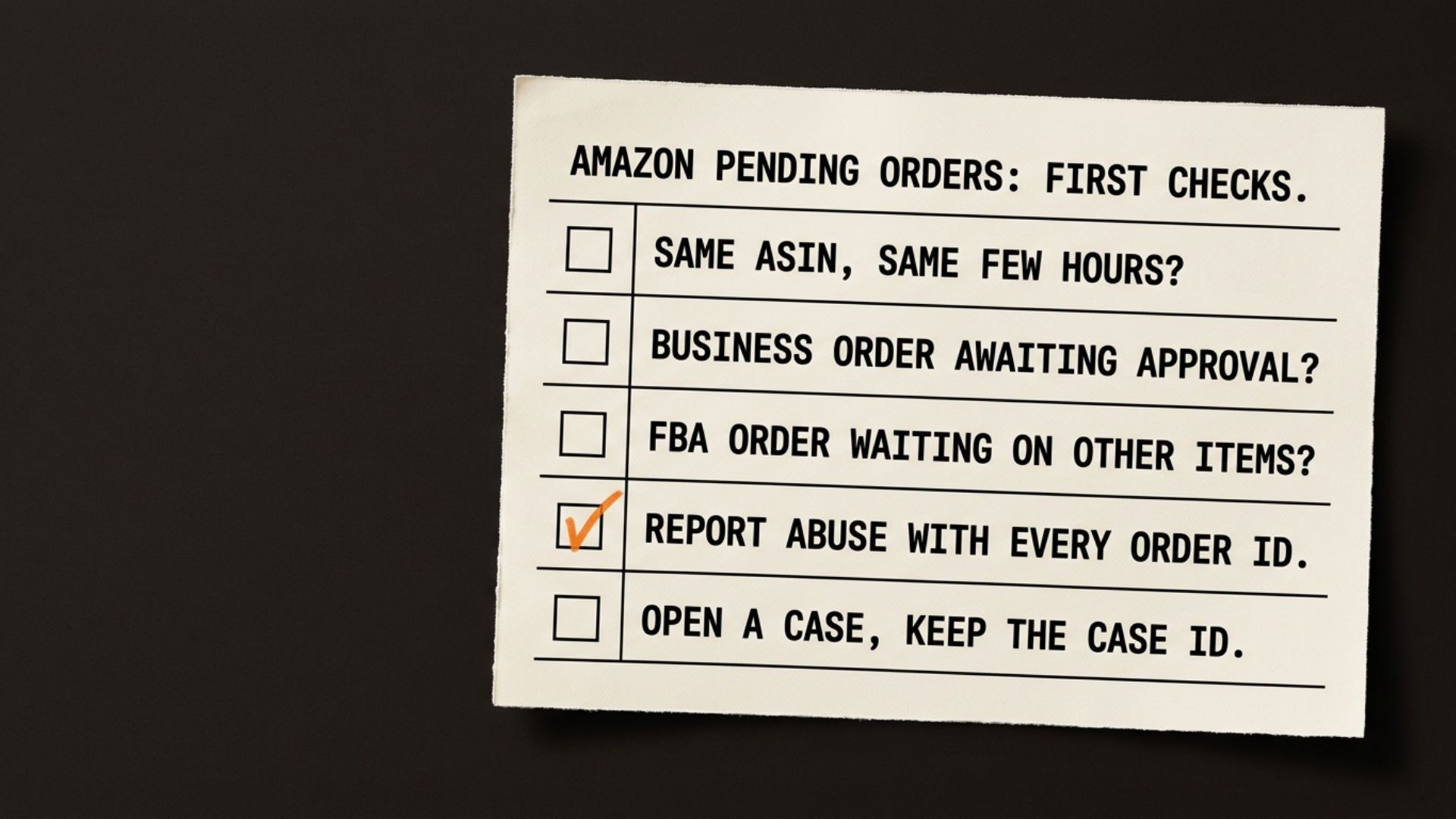
What to check first when pending orders pile up
The order matters here, because the first hour decides how good your evidence is later.
- Look at the Pending tab, by ASIN and by time. Amazon says pending orders sit under the Pending tab in Manage orders, with FBA ones on the Fulfilment by Amazon orders view. They do not appear in the Order Report, which is why they are easy to miss until stock looks wrong.
- Rule out the ordinary causes. Business orders, Subscribe & Save and multi-item FBA orders all have a reason that is not fraud. If the burst is all business orders, the approval window is one possible explanation.
- Compare it with your normal week. The Register reported some sellers seeing double or triple their usual weekly volume. Your own baseline is the most persuasive number you have.
- Check what is actually left to sell. If the pending units have taken a listing to zero, every genuine buyer is now going elsewhere. That is the cost to stop first.
How pending order stock locks get handled
Nothing below releases the units early. Nothing in our research shows Amazon doing that on request, and we would rather say so than imply otherwise. What these steps do is limit the damage and put the pattern in front of the people at Amazon who can investigate it.
Report the pattern, not the feeling
Cooper_Amazon pointed sellers to the Report Abuse tool where they believe abusive behaviour is happening. In the 78 orders thread, Danny_Amazon explained that the name of a suspected competitor is an optional field when reporting through the violation pathway. You do not have to know who it is.
What helps is the facts in one place: every pending order ID, the ASIN, when each order arrived and how that compares with normal. Frustration is not evidence. A list of order IDs is.
Open a case, and keep the case ID
A Seller Support case gives the report a reference. On the Pending Payment Scam Orders thread, Topher_Amazon asked the seller to share the case number there so he could take a look and escalate if needed. In September 2026, a forum message posted hours after The Register contacted Amazon said the UK issue had been escalated to Amazon’s partner teams.
Shopifreaks reports that Seller Support first called the September activity normal. If you get the same answer, that is a first reply, not the end of the case.
Limit what each order can take
Amazon offers have a Max Order Quantity setting that caps how many units a buyer can order, as described in LandingCube’s guide to setting a max order quantity and ManageByStats’ guide to maximum quantity. Sellers on the forums recommend setting it low on a targeted listing.
It is worth being honest about what it does. A limit means locking the same stock takes more orders. It does not stop single-unit orders, and each of the 78 orders in that forum thread was for one unit. It raises the effort, it does not close the door.
Keep genuine buyers able to buy
If you hold stock outside FBA, a seller-fulfilled offer on the same product can let real customers keep buying while the FBA units are locked. That is our reasoning rather than an Amazon instruction, and it only helps if you can ship to the standard your account is measured on. If you cannot, the better move may be bringing your next FBA shipment forward.
When the window does end and the orders cancel, the units come back, but the rank you lost while the listing showed zero does not always come straight back with them. Our guide to recovering rank after a stockout covers that part, and why a listing says currently unavailable when you have stock covers the other places stock can go missing on the page.
How to stop it costing you twice
You cannot stop someone placing an order. You can make sure a wave costs you less, and that you see it on day one rather than day ten.
- Watch pending against your baseline: a daily look at the Pending tab for your top ASINs catches a burst while there is still stock to protect.
- Keep a simple log: date, ASIN, order ID, value and status, every day the wave runs. It is your evidence for the case, and it shows the stockout was not a forecasting mistake.
- Do not count on compensation: we found no Amazon reimbursement route for sales lost while units sat in pending orders. Plan stock for Q4 as if the risk is yours, because today it is.
- Keep cover in the pipeline: a hero ASIN with only a few weeks of FBA stock has no room to absorb 21 days of locked units. The same thinking sits behind keeping your IPI score healthy, so you have the capacity to send more when you need it.
- Do not ship pending orders: Amazon says not to, even if the buyer contacts you directly, and to refer them to Amazon Customer Service.
Get your Q4 stock watched before a wave hits it
Pending order waves are a stock problem first and a case problem second. Catching one early, telling it apart from ordinary business orders, and getting a clean report in front of Amazon is a lot of small work at exactly the time of year you have none to spare.
That is the kind of work our inventory management team does for brands: watching stock on the ASINs that matter, keeping the record, and helping you build the case. We cannot make Amazon release the units early, and we will not pretend to. Get in touch and we will look at your Q4 stock position with you.
Common questions about Amazon pending orders
How long can an Amazon order stay pending?
Amazon's Pending Orders help page says its payment and order detail verification can extend processing by as much as 21 days. An Amazon forum moderator says that if payment falls through in that time, the order is cancelled and the units go back into your inventory.
Can I cancel a pending order on Amazon?
No. Amazon's help page says the Confirm shipment and Cancel order buttons only appear once the buyer's payment method has been verified. If a buyer contacts you about a pending order, Amazon says to refer them to Amazon Customer Service.
Do pending orders reduce my available inventory?
Yes. Amazon says the quantity available for the listing is subtracted from your quantity in Manage Inventory while the order is pending. If only one unit was left, the listing comes off the offer page and shows zero until the order is processed.
Are fake pending orders on Amazon UK a competitor attack?
Nobody has shown that yet. Some UK sellers suspect rivals are ordering with cards that lack the funds, but The Register reported on 25 September 2026 that there was no evidence yet that the activity was malicious rather than an Amazon glitch. A forum message said the reports had been escalated to Amazon's partner teams, and as of 5 October 2026 we found no public statement from Amazon on the cause.
Will Amazon compensate me for sales lost to pending orders?
We found no Amazon reimbursement route for sales lost while units sat in pending orders. An Amazon forum moderator says the units return to inventory if the orders are cancelled, so the realistic aim is limiting the time your listing shows zero, not recovering the lost sales.
Sources
- Amazon sellers watch as inventory vanishes into pending-order purgatory, The Register (third party, 25 September 2026)theregister.com
- Pending Orders, Seller Central help (UK)sellercentral.amazon.co.uk
- Cooper_Amazon on pending orders and Report Abuse, Amazon Seller Forumssellercentral.amazon.co.uk
- Pending Orders, Seller Central help (US)sellercentral.amazon.com
- Amazon UK sellers see high-value stock frozen by pending orders, Shopifreaks (third party, 27 September 2026)shopifreaks.com
- Pending Payment Scam Orders, with Topher_Amazon's reply, Amazon Seller Forumssellercentral-europe.amazon.com
- 78 Fake Orders, with Danny_Amazon's reply, Amazon Seller Forumssellercentral-europe.amazon.com
- How to set a max order quantity, LandingCube (third party)support.landingcube.com
- Maximum quantity, ManageByStats (third party)managebystats.com
Founder, AVA INC.
Shilpi Dudani is the founder of AVA INC. Her team manages Seller Central accounts, fixes catalog problems and optimizes listings for Amazon sellers.
Not sure whether this is your problem?
We will look at your account and tell you what is actually wrong before you spend anything.
Get your free, no-obligation audit