Amazon reference price gone: why your strikethrough vanished before Black Friday
Your Amazon strikethrough price shrank or vanished? The 2026 List Price and Typical Price rules, what to check per ASIN, and why amazon.de differs.

- 12 min read
- FBA & Operations
Fact-checked against Amazon's own pages on 25 Oct 2026
On this page
The short answer
- Two reference prices: on Amazon.com the strikethrough is generally your List Price or a Typical Price that Amazon calculates as a 90 day median, and both update without advance notice.
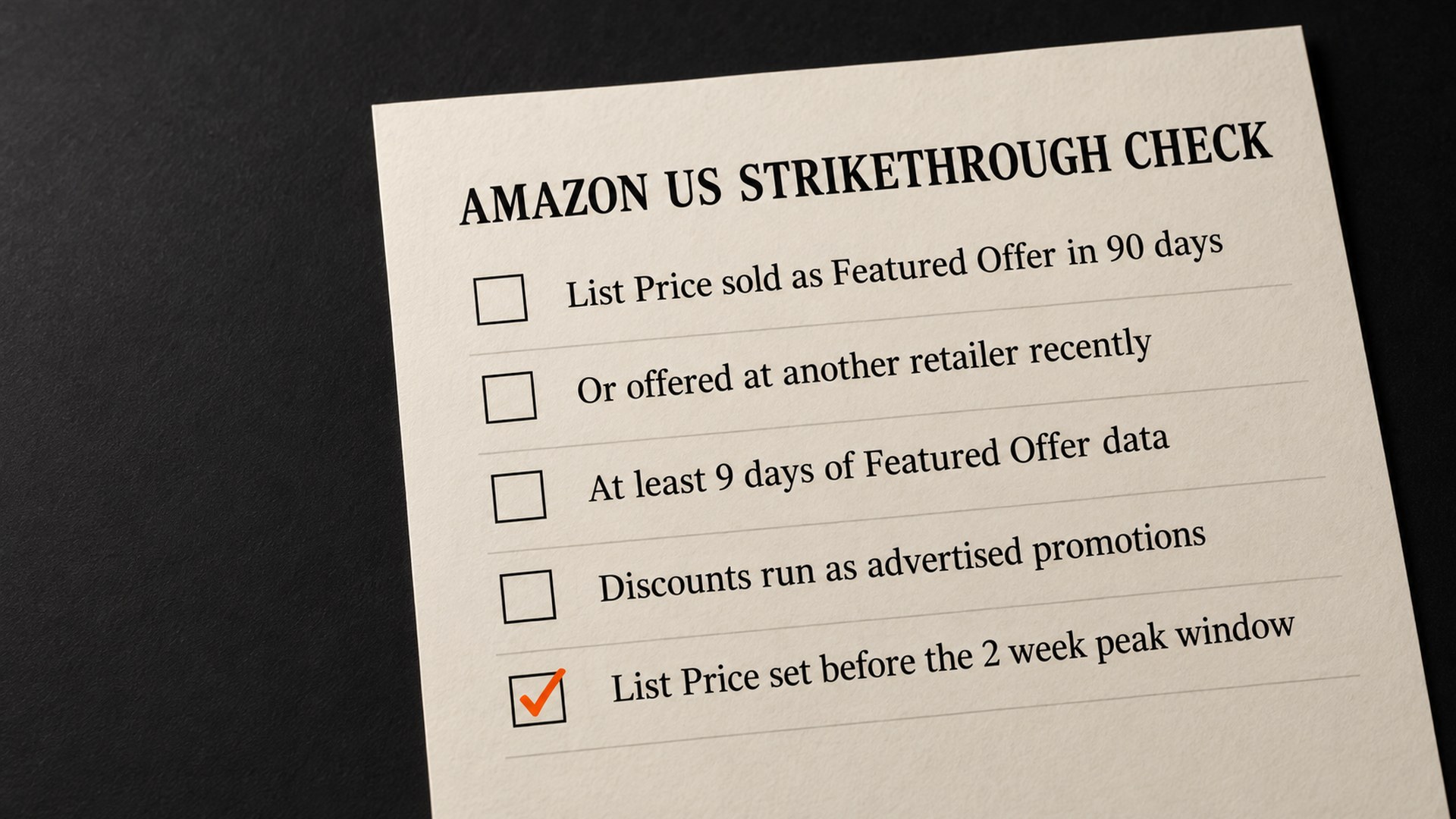
- List Price, from 23 April 2026: it only validates if customers bought the product as the Featured Offer at that price on Amazon, or another retailer offered it at that price recently.
- Typical Price, from 18 May 2026: if your Featured Offer sat below your usual price for more than half of the last 90 days, Amazon counts promotional sales too. Separately, quiet price cuts always count as normal sales.
- Peak timing: for ASINs with 30 or more days of price history, Amazon excludes the 2 weeks before and during a peak event when it validates a List Price from sales, so a price raised just before an event does not help.
- Germany is different: amazon.de shows a median Statt-Preis, and a Munich court ruled in July 2025 that Amazon’s discount display had to refer to its own 30 day lowest price. Amazon has appealed.
In October 2026 a seller posted on Amazon’s US forums under the title “Incorrect Reference Price Restricting Deal Price in Amazon USA”. Their Deals page showed a current price of $25.99, but Amazon was using $21.84 as the reference price and capping the deal at $19.66, while Manage Inventory showed a Featured Offer of $20.74. They had asked Seller Support where the $21.84 came from. An Amazon moderator replied that earlier coupons or promotions, or a lower offer from another seller, could explain it.
The Amazon reference price behind your strikethrough is calculated by Amazon, it changes without notice, and two rules introduced in spring 2026 made it easier to lose. When it goes, the crossed-out price can drop to a lower Typical Price or disappear, and your Black Friday deal can be capped lower than you planned or blocked altogether.
Why did my Amazon reference price disappear?
Amazon’s reference pricing and promotions FAQ says reference prices “are generally displayed as a List Price or Typical Price (known as Was Price in some stores, Median Price in select EU stores, and Previous Price in Mexico and Brazil).” The same page adds that they set the baseline for promotions: deals, coupons and price discounts during peak events all need a minimum percentage off the reference price.
Amazon announced two changes in a post titled Upcoming Improvements to Reference Pricing on its US Seller Forums.
The List Price rule, from 23 April 2026
From 23 April 2026 a List Price you provide has to meet one of two criteria. The product has been offered at that List Price at another retailer recently, or customers have bought it as the Featured Offer on Amazon at that List Price.
Amazon’s list price help page fills in the detail. The lookback is 90 days. For Amazon sales, only orders at Featured Offer prices count, and Amazon says “You need both sales at the list price, and the list price should match the Featured Offer price for a meaningful number of days in the last 90 days.” A price matches when it equals the List Price or sits a small margin above it. A product needs at least 9 days of Featured Offer data before Amazon sales can validate it.
An MSRP that was never charged has the hardest time here. A $100 List Price on a product that has sold at $69 all year, for example, has nothing behind it on Amazon. The Amazon policy on reference prices says it directly: “If Amazon cannot verify your List Price, we might not use it.”
The Typical Price rule, from 18 May 2026
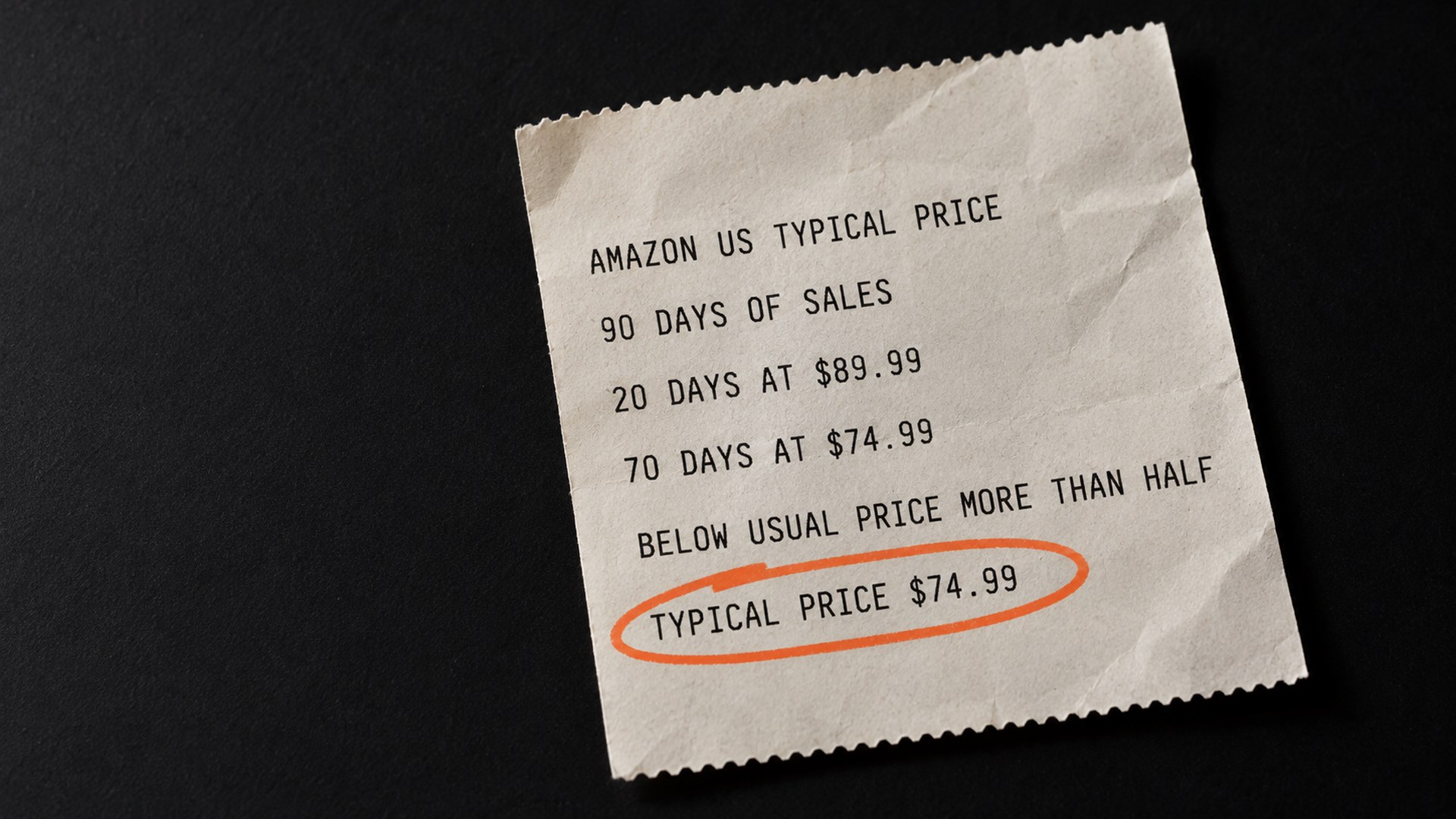
Typical Price is the median non-promotional price customers paid over the last 90 days. From 18 May 2026, if more than half of those 90 days show the Featured Offer below your usual non-promotional price, Amazon calculates Typical Price from all sales, promotional ones included.
Amazon’s FAQ gives a worked example with a pair of sneakers. At $89.99 for 60 days and $74.99 for 30 days, the Typical Price stays at $89.99. At $89.99 for only 20 days and $74.99 for 70 days, the product was below its usual price for more than half the period, and the Typical Price becomes $74.99.
The second half of the rule is the one a repricer can trip. Amazon’s FAQ says “Price discounts that are not advertised to customers as promotions are treated as non-promotional sales and are included in Typical Price.” A repricer that drops the price to follow a competitor, or a manual cut you never set up as a promotion, counts as a normal sale. Enough of those and the median moves down with them.
The FAQ also names what is left out. Buy X Get Y promotions, Subscribe and Save and tailored coupons are excluded, and “Sales that occur during peak events are always excluded from the Typical Price calculation.” Prime Day is the peak event it names. My reading is that the risk sits in the weeks around an event, not the event days themselves.
How to tell which reference price you lost
Amazon does not warn you in advance. The FAQ says “Both Typical Price and List Price update regularly without advance notice.” A seller replying to the announcement asked whether Amazon would release data to monitor it, “Or are we going to be flying blind?”
These places do show something:
- Price history on the detail page: Amazon says a valid List Price appears as a visible data point in Price history over the last 90 days. That applies to a List Price validated through Amazon sales; one validated through another retailer need not show there.
- The monthly email: Amazon sends “Add or update a list price to your listings” for ASINs where a List Price is missing or could not be validated.
- The Manage Deals page: the Maximum deal price draws on reference prices, recent promotions, recent sales and the lowest new-condition offer from any seller. A maximum far below what you expected can mean the reference price moved, or that another seller had a lower new-condition offer. Our guide to the Amazon Black Friday deal deadline and Max Price check covers that screen.
- Needs Attention alerts: Amazon suggests checking them two weeks before a deal starts and while it runs.
What to check first, ASIN by ASIN
Start with the ASINs you plan to promote over Black Friday week. For each one, I would note four things side by side: the List Price you hold, the Featured Offer price over the last 90 days, whether a strikethrough shows today, and which of your price changes in that period were set up as promotions.
- List Price never charged: if your List Price is an MSRP the product has not sold at as the Featured Offer, and no other retailer offers it at that price, Amazon has nothing to validate it with.
- Too many quiet cuts: if the Featured Offer was under your usual price for more than half of the 90 days through cuts that were not advertised promotions, Typical Price now includes them.
The repricer is the one I would check most carefully, because its rules are easy to set once and forget, and every unadvertised drop it makes now feeds the median. If it is chasing the Featured Offer and the Buy Box, that trade-off is worth deciding on purpose.
How a lost strikethrough gets fixed
Amazon’s FAQ says that if the inputs used to validate reference prices change, the reference price shown may change too, so most of the fix is changing those inputs in the right order. The moderator on the October thread said the reference price “is not something that can be manually adjusted”, and suggested reopening the case and asking for escalation to the Deals/Pricing Specialist Team where the data looks wrong.
- Make the List Price one you can stand behind: Amazon’s policy says a List Price must represent a price at which you or other retailers “have recently made or intend to make substantial sales”. If your current one fails that, replace it with a price you have actually charged or that another retailer offers. Amazon suggests the first price you offered the product at if you have no List Price, or 0 to say you have none.
- Update it where Amazon reads it: the field is List price in the Offer tab of the listing, or list_price in the inventory template for a bulk change. Amazon says changes typically show within a few hours on Manage All Inventory.
- Move discounts into promotions: run price cuts as advertised promotions rather than silent changes to the offer price. Once the Featured Offer has been below your usual price for more than half of the 90 days, Amazon counts all sales, promotional ones included, apart from the exclusions above. An Amazon moderator on the announcement thread also said that a sale price set in the listing, and a Price Discount without deal badging outside an event, do not count as advertised.
- Give the price time on the Featured Offer: validation through Amazon sales needs the List Price to match the Featured Offer for a meaningful number of days in the last 90. Amazon does not say how many days.
Amazon’s list price page says that for ASINs with 30 or more days of price history it temporarily excludes “the 2 weeks leading up to and during peak events”, so “price increases right before peak events won’t count for this validation.” A List Price that is not validated before that window opens cannot be validated through Amazon sales during it. The page does not list which events count as peak events, so I would treat Black Friday week as one and finish List Price work by early November.
A seller under Amazon’s announcement asked whether a brand’s own website counts as another retailer. An Amazon moderator replied that it can, “provided it’s not flagged as an outlier by our competitive pricing tools.” That is a forum reply rather than the help page, so I would not make it your only route.
Why amazon.de shows a different number
Every help page quoted above applies to selling in the United States. Germany uses a different number, under a different law.
On amazon.de the reference price is the Statt-Preis. Onlinehändler News, the news site of the German retailers’ association Händlerbund, quotes Amazon’s own explanation in its 7 October 2026 article on Amazon’s Prime Deal Days price display: “Der Statt-Preis ist der mittlere Verkaufspreis, den Kunden für ein Produkt bei Amazon.de zahlen”, the median price customers pay on Amazon.de, with half paying less and half paying more, excluding limited-time promotional prices.
German price law asks for something else. Section 11 of the Preisangabenverordnung (PAngV) requires anyone announcing a price reduction to consumers to state the lowest total price they charged in the previous 30 days. It concerns comparisons with your own earlier price, and IT-Recht Kanzlei’s explainer on the 30 day lowest price rule notes that the duty falls on every business.
On 14 July 2025 the Munich Regional Court (Landgericht München I, case 4 HK O 13950/24) ruled against Amazon in a case brought by the Verbraucherzentrale Baden-Württemberg over crossed-out prices and advertised discounts that did not refer to Amazon’s own lowest price of the last 30 days. According to the Verbraucherzentrale’s case page, Amazon has appealed to the Higher Regional Court in Munich, so the ruling is not final.
The ruling is against Amazon. Where I think it touches you is any price reduction you announce yourself. If you show a crossed-out price to German consumers, in your shop, a newsletter or an ad, PAngV can apply to you as the business making that announcement, so keep a record of your lowest price over each 30 days. This is general information, not legal advice.
How to stop it happening again
- Treat the List Price as a record: set it to a price you charge or another retailer charges and review it whenever your regular price changes, since Amazon makes you responsible for keeping it current. Settling your pricing strategy and margins first makes that easier.
- Put discounts through promotions, in moderation: since 18 May 2026 a cut not advertised as a promotion counts towards your Typical Price, promotions on more than half of the 90 days are counted too, and a forum reply from Amazon says a listing sale price does not count as advertised. Their fees belong in your Black Friday deal cost stack.
- Audit the repricer: check its rules for following competitors before each event season.
- Plan around the peak window: finish any List Price change before the 2 week exclusion for the next peak event begins, then leave it alone.
Get your reference prices checked before Black Friday week
I understand how frustrating it is to lose a saving badge with no message from Amazon and no number to look at. Many of the causes in this guide can be traced, ASIN by ASIN, in your own price history.
That tracing is part of our listing optimization work. We go through the ASINs you want to promote, compare each List Price with your 90 days of Featured Offer prices, find the quiet cuts and repricer moves that pulled Typical Price down, and tell you what can realistically change before the peak window. I cannot promise Amazon will show a strikethrough on any given ASIN, because Amazon decides that, but we can line your prices up with what Amazon says it checks. You can book a free audit and we will start from your Seller Central.
Common questions about the Amazon reference price
Why is my Amazon strikethrough price not showing
On Amazon.com the strikethrough is a List Price or a Typical Price. Since 23 April 2026 a List Price only validates if customers bought the product as the Featured Offer at that price, or another retailer offered it at that price recently. Since 18 May 2026 a Typical Price can fall when the product sold below its usual price for more than half of the last 90 days.
How does Amazon calculate Typical Price
Amazon describes Typical Price as the median non-promotional price customers paid over the last 90 days. From 18 May 2026, if the Featured Offer was below the usual non-promotional price for more than half of that period, Amazon includes all sales, promotional ones too. Sales during peak events are always excluded.
Do price cuts from my repricer affect my Amazon reference price
They can. Amazon's FAQ says price discounts that are not advertised to customers as promotions are treated as non-promotional sales and are included in Typical Price. In practice, a repricer cut is not set up as a promotion, so it counts as a normal sale.
How long does Amazon look back to validate a List Price
Amazon's list price help page says the lookback is 90 days, and a product needs at least 9 days of Featured Offer data to validate through Amazon sales. For ASINs with 30 or more days of price history, Amazon excludes the 2 weeks before and during a peak event, so a price raised just before an event does not count.
Will Amazon tell me when my reference price changes
No. Amazon's FAQ says both Typical Price and List Price update regularly without advance notice. Amazon does send a monthly email titled "Add or update a list price to your listings" for ASINs whose List Price is missing or could not be validated.
Why does amazon.de show a different strikethrough price
On amazon.de the reference price is the Statt-Preis, which Amazon describes as the median price customers paid on Amazon.de. German law requires anyone announcing a price reduction to state their lowest price of the last 30 days, and a Munich court ruled against Amazon's discount display on 14 July 2025. Amazon has appealed, so the ruling is not final.
Sources
- Incorrect Reference Price Restricting Deal Price in Amazon USA, seller post, US Seller Forumssellercentral.amazon.com
- Show a reference price by providing a list price, Seller Central help (US)sellercentral.amazon.com
- Upcoming Improvements to Reference Pricing, Amazon announcement, US Seller Forumssellercentral.amazon.com
- Reference pricing and promotions FAQ, Seller Central help (US)sellercentral.amazon.com
- Amazon policy on reference prices, Seller Central help (US)sellercentral.amazon.com
- Amazon's Prime Deal Days price display, Händlerbund (third party), 7 October 2026ohn.haendlerbund.de
- The 30 day lowest price rule, IT-Recht Kanzlei (third party), 24 March 2025it-recht-kanzlei.de
- Klage gegen Amazon, Verbraucherzentrale case pageverbraucherzentrale.de
Founder, AVA INC.
Shilpi Dudani is the founder of AVA INC. Her team manages Seller Central accounts, fixes catalog problems and optimizes listings for Amazon sellers.
Not sure whether this is your problem?
We will look at your account and tell you what is actually wrong before you spend anything.
Get your free, no-obligation audit