Walmart target ROAS in SEM: when to switch it on and when to wait
Walmart SEM now offers Maximize conversion value, target ROAS and daily budget automation. Which to pick, how the bidding learns, and what to check first.

- 12 min read
- PPC & Advertising
Fact-checked against Walmart's own pages on 24 Nov 2026
On this page
The short answer
- What SEM is: Walmart's Self-Serve SEM runs Google Shopping ads for your Walmart.com offers, paid per click, from the Advertising menu in Seller Center.
- What changed: in the setup guide as of November 2026, the two bidding strategies are Maximize conversion value and target ROAS. In April 2026 the guide offered Maximize clicks instead of Maximize conversion value.
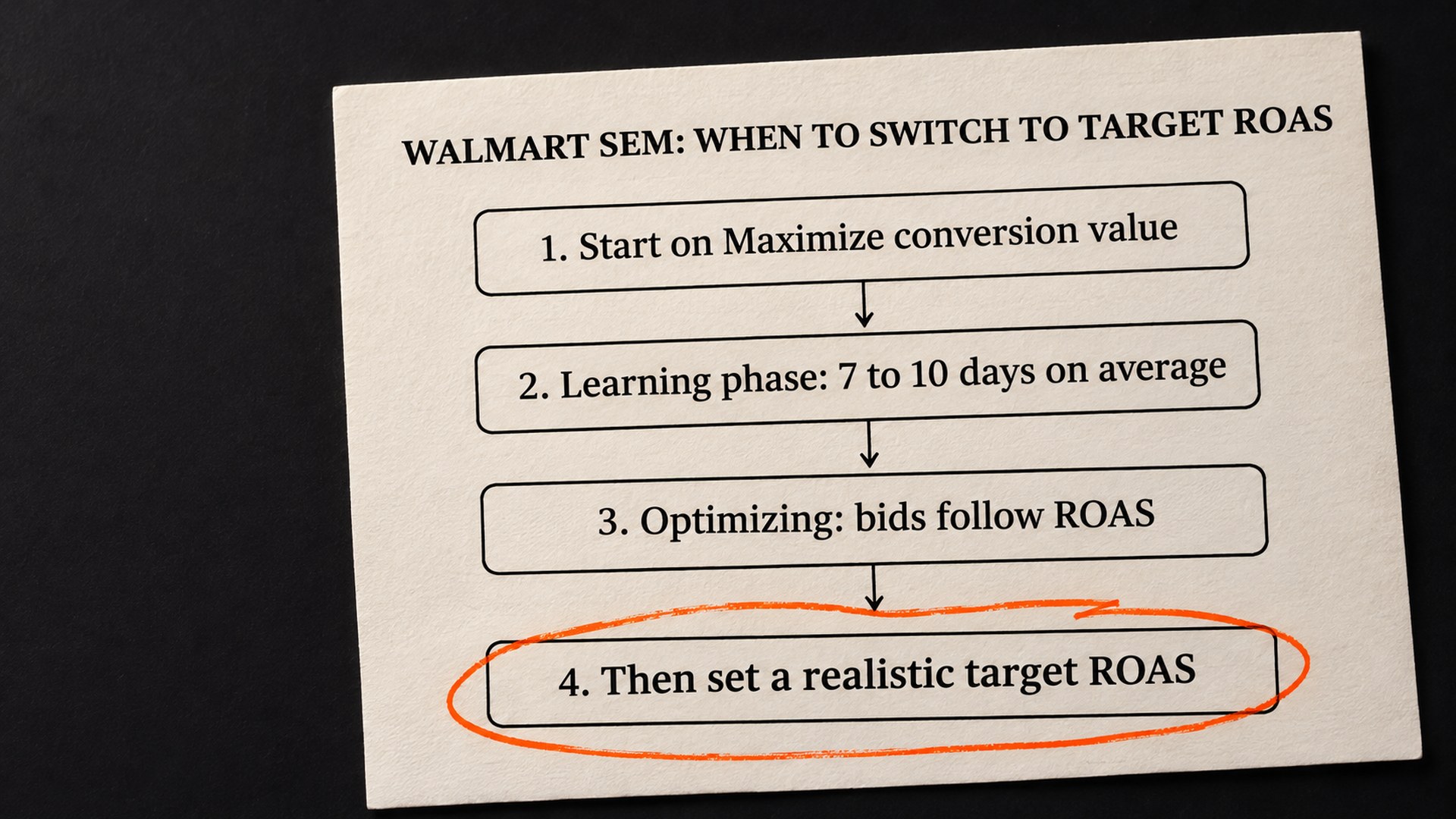
- Where to start: Walmart's own tip is to start an all-items campaign on Maximize conversion value and consider tROAS once the campaign has enough data.
- The tROAS catch: set the target too high and the campaign may not spend its budget, because the algorithm finds fewer auctions it thinks it can win profitably.
- Budget automation: it raises the daily budget when the campaign runs out two days in a row and meets your ROAS criteria. Walmart's guides do not say how much it adds or whether there is a cap.
- The Buy Box does not stop it: SEM ads keep running when you lose the Buy Box, unlike Sponsored Search.
Walmart's SEM campaign setup guide, last updated on 2 November 2026, now says: "Choose between Maximize conversion value or Target Return on Ad Spend (tROAS)." In the April 2026 copy of the same guide, that choice was between Maximize clicks and tROAS.
So Walmart target ROAS bidding is not new. What is new since April is the strategy that sits next to it, plus a switch called Daily budget automation that can raise your budget for you. Once switched on, both let Walmart decide how much of your budget to spend, and you are likely to meet them while setting up holiday campaigns.
One thing to settle first, because the names make it easy to mix up. Walmart's Search Engine Marketing program does not put ads on Walmart.com. It buys Google Shopping ads for your Walmart items. That changes how you should read every number it gives you.
What Walmart target ROAS bidding does in SEM
Start with what the product is. The SEM program overview on Walmart Marketplace Learn describes it as "a paid advertising tool that enables you to create Google Shopping ads for your Walmart products." The ad shows on Google.com. A shopper who clicks lands on your offer on Walmart.com. You pay per click, and Walmart's FAQ says there are no additional fees and the charges are billed through your normal settlement, with your payment method charged if they ever exceed your account balance.
Inside that, you pick one of two bidding strategies. Walmart sets the bids either way. You only choose what it aims for.
- Maximize conversion value: Walmart sets bids "to drive the highest possible sales within your budget." It tries to spend the budget.
- Target ROAS (tROAS): Walmart sets bids "to maximize sales based on your Target Return on Ad Spend." It tries to hit the return you asked for, and it will hold back spend to do it.
That second point is the whole decision. Maximize conversion value treats your budget as the limit. tROAS treats your return as the limit. If Google demand for your item cannot deliver the return you set, a tROAS campaign spends less, and the SEM campaign setup guide says so plainly: "You may not spend your entire budget unless the tROAS is achievable."
Why the switch from Maximize clicks matters
The old option bought traffic. The April copy of the guide said Maximize clicks gets "as many clicks as possible within your budget" and warned that returns "may fall below expectations." The new starting point Walmart recommends aims at sales value. For a seller, that is a better starting point, because a click on Google that never buys still costs you, and Walmart now steers the bids toward sales value rather than visits.
Walmart's guides do not say what happened to campaigns that were set to Maximize clicks. If you set one up in the spring and left it, it is worth opening it to see which strategy it shows today.
How to know which strategy your campaign needs
Walmart's setup guide has a table for this. This is how I read it for a brand that already sells on Amazon.
- You are new to SEM, or adding a broad range of items: Maximize conversion value. Walmart lists "trying a new campaign with a broad assortment of items" and "supporting product launches or seasonal events" under it.
- You already know the return you need: tROAS. Walmart lists "prioritizing sales if you already have a ROAS goal."
- The items already performed well in SEM recently: tROAS. Walmart's wording is products that "have historically performed well in SEM (for orders in the last 30 days)."
- Your campaign is spending far below budget on tROAS: the target is probably too high for the demand on Google. Walmart's answer is to lower it.
Notice what is missing. Walmart does not say how many orders count as "sufficient data," and it does not publish a minimum. Walmart's guides publish no minimum, so a hard number for Walmart SEM is someone's own rule.
What to check first, before you change the bidding
Walmart SEM is easy to misread if you come to it from Sponsored Products on Amazon. These checks come before any change to the strategy, in the order we would do them.
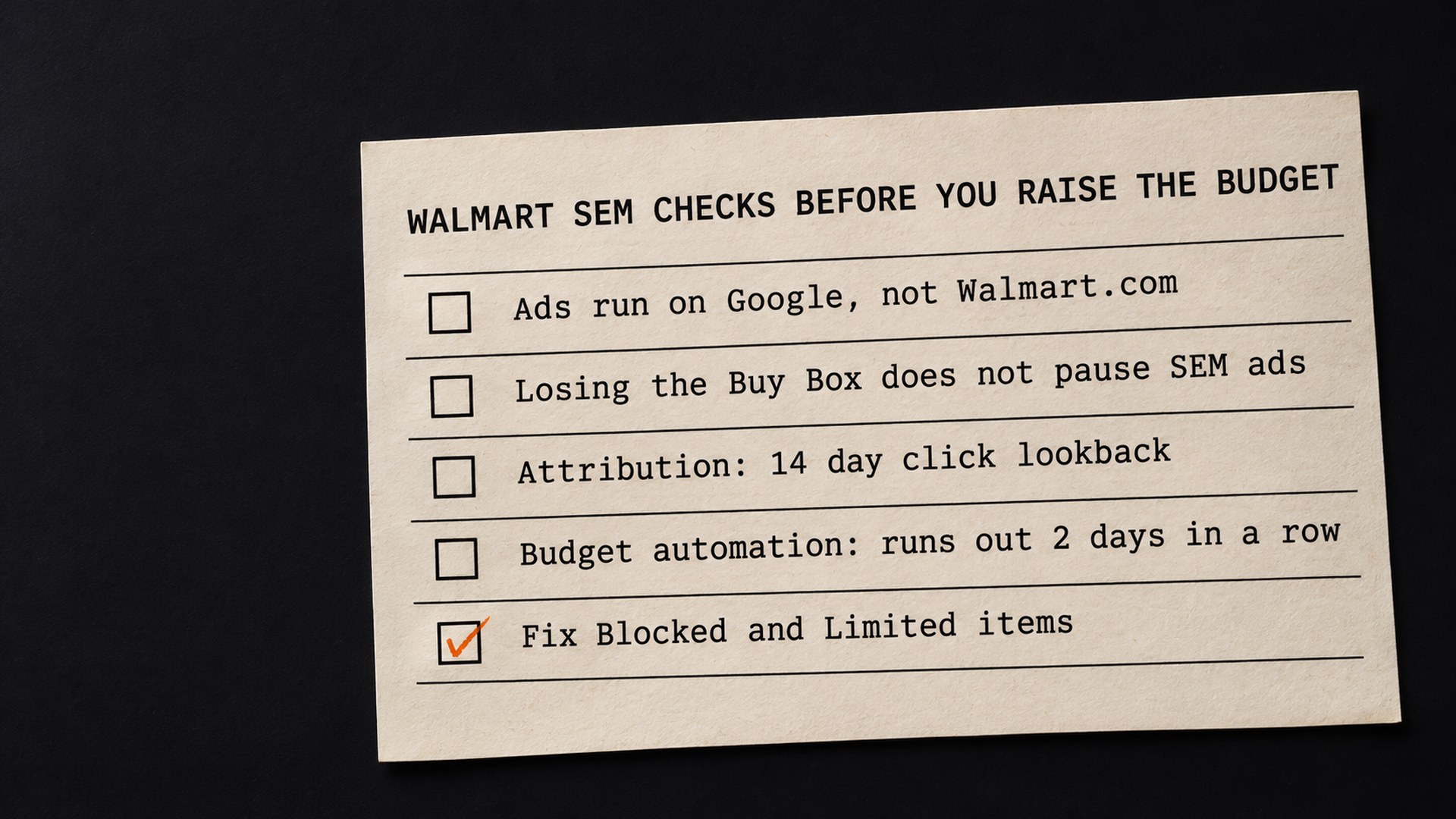
- Which ad product you are looking at. SEM is Google traffic. Sponsored Search, from Walmart Connect, is ads on Walmart.com. Walmart's FAQ draws the line: Sponsored Search ads "are only shown if the offer is winning the Buy Box," while SEM ads show regardless. A ROAS figure from one tells you nothing about the other.
- Whether you still hold the Buy Box. The SEM campaign management guide answers this one directly: the ads are not paused when you lose it, and "Your Buy Box win rate does not impact your campaign performance." That is good news for reach. Our view is that it also means a campaign can keep buying clicks for an offer that is not the Buy Box winner, so we would watch ROAS closely on any item where the Buy Box keeps moving.
- How Walmart counts a sale. Walmart's overview says it uses "a proprietary 14-day lookback model based on customer clicks." A sale up to 14 days after a click can be credited to the ad. Judge a campaign on yesterday's numbers and you are judging it before its sales have finished arriving.
- Item health. The campaign page has an Active item summary that sorts your ads into Blocked, Limited and No issues. Walmart says to resolve blocked or limited items to avoid interruptions. Changing the bidding strategy will not help an item that is not allowed to show.
- Who can edit. Only Seller Center users with admin access can create and modify SEM campaigns, according to the setup guide. If your team member cannot see the edit buttons, that is why.
If you also run Amazon ads, the third point is the one that catches sellers out, because a comparison between channels only works when both use the same lookback window.
How Walmart's bidding behaves after you switch
Walmart describes two phases, and knowing them saves a lot of panicked edits.
- Learning: the algorithm tests bid levels to see how your item performs on Google Shopping. Walmart says you may see few impressions and clicks or an inconsistent ROAS, that this is normal, and that it "takes an average of 7-10 days and may take longer if there's high competition in Google."
- Optimizing: the algorithm bids only where extra spend is expected to return an optimal ROAS. Spend can rise at a stable return. On items it cannot make work, because of low demand or high competition, it cuts spend.
That second phase explains a complaint Walmart answers in its own FAQ, a campaign that spends less than it did before. When an item leaves learning, Walmart may lower its bid to where it predicts a satisfactory return, and lower bids win fewer clicks. That is the system working, not a fault.
Walmart's management guide adds one more instruction for tROAS: "As campaign performance stabilizes, gradually increase your tROAS based on your campaign goals and performance." Gradually is the word to keep. Walmart does not say how the algorithm reacts to a change of target, so our habit is to change it in small steps and give each one time.
Setting a target ROAS you can defend
Walmart's advice is to "start with a realistic tROAS target," and it warns that a target set too high "could limit bidding opportunities and result in lower spend." It does not tell you what realistic means for your product, so this part is our reasoning, not Walmart's rule.
Work from your own break-even ROAS: the return at which an ad sale covers its ad cost and nothing more. It comes from your margin on Walmart before ad spend, after your product cost, Walmart's referral fee and your fulfilment cost. As an example only, an item that keeps 25 percent of its price before ads breaks even at a ROAS of 4, because each dollar of ad spend needs four dollars of sales to pay for itself. A target below your break-even buys sales at a loss. A target far above it starves the campaign.
Use your Walmart margin, not your Amazon one. The fees are different, and so is the shipping, so a target copied across from Amazon is a guess dressed up as a number.
Daily budget automation: what it does to your spend
This is the newer switch, and it sits under Scheduling and budget when you create a campaign, or under Budget when you edit one. Walmart's wording, in both guides, is that it increases your daily campaign budget "when it runs out two days in a row and meets your specified ROAS criteria."
Read that carefully, because the guardrail is the ROAS criteria you set. Two things Walmart does not say: how much the budget goes up, and whether there is a ceiling. I would not switch it on without knowing your break-even ROAS first, and I would check the campaign's spend every day while it is on.
Three campaign statuses tell you whether budget is the real problem.
- Budget exhausted: the campaign is paused because it has $0 of daily budget left, and it resumes when budget is added.
- Limited by budget: a low budget is stopping your ads from reaching more shoppers searching for your products.
- Ending soon: the campaign ends within seven days. The setup guide says an end date must be at least 21 days after the start date, so a campaign meant for a few days has to be stopped by hand.
For Black Friday and Cyber Monday, that 21 day rule means a campaign started in late November runs well past the holiday weekend unless you stop it yourself.
How to stop SEM spend drifting again
Campaigns on automated bidding do not drift because the algorithm is careless. They drift because nobody looks at them after the first week. A short routine is enough.
- Weekly, not daily, for strategy changes: our habit is to give a change at least a week or two before judging it, partly because of the 14 day attribution window.
- Daily, while budget automation is on: check spend against the budget you meant to set.
- After every price change: Walmart's FAQ points to listing quality, competitive pricing and fast shipping as the levers for a running campaign. A price rise can lower ROAS without the campaign changing at all.
- On low click-through after learning: Walmart says to review the title, description, images, price, shipping and availability. A low ROAS in the optimizing phase, Walmart says, may point instead at the page the shopper lands on.
The same listing work helps both your Walmart and Amazon ads. If your Amazon ad costs are the bigger worry right now, our guides on cutting high ACoS on Amazon and reading TACOS as your growth metric cover that side. For a campaign that keeps running dry before the day ends, there is our Amazon guide to budgets that run out early. And if you are new to Walmart altogether, start with how Walmart's seller metrics differ from Amazon's.
Get your Walmart listings in order before the ads spend on them
Automated bidding on Walmart is easy to switch on. The harder part is knowing whether the target you typed in is a profit or a loss, and whether a campaign that went quiet is broken or doing exactly what you told it to. Walmart's own FAQ says a running campaign improves through listing quality, competitive pricing and fast shipping, and that part sits outside the bidding altogether.
That is the work our Walmart seller services cover: the catalogue, listing quality and the item errors that stop a listing from showing at all. I cannot promise what any campaign will return, but we can make sure the pages your ads send shoppers to are ready for them. If you sell the same products on Amazon, our free audit of one Amazon listing is an easy way to see how we work first.
Common questions about Walmart target ROAS in SEM
Is Walmart SEM the same as Walmart Connect Sponsored Search?
No. Walmart's SEM program overview says SEM ads appear to shoppers searching on Google, while Sponsored Search ads show to customers already on Walmart.com and only when your offer is winning the Buy Box. Their numbers should be read separately.
Should I start a Walmart SEM campaign on target ROAS?
Walmart's own tip is to start an all-items campaign on Maximize conversion value and consider target ROAS once the campaign has generated enough data. Walmart suggests target ROAS when you already have a ROAS goal, or for products that have performed well in SEM, judged on orders in the last 30 days.
Why is my Walmart target ROAS campaign not spending its budget?
Walmart says the algorithm lowers bids when it cannot reach your target because of limited demand, and a target set too high leaves it fewer auctions to bid in. Its suggestion is to lower the target ROAS, then watch the results and adjust.
How does Walmart daily budget automation work?
When it is switched on, Walmart increases the campaign's daily budget when the budget runs out two days in a row and the campaign meets the ROAS criteria you set. Walmart's guides do not say how large the increase is or whether there is a cap, so check spend daily while it is on.
How long does the Walmart SEM learning phase take?
Walmart's campaign setup guide says it takes an average of 7 to 10 days and may take longer when competition on Google is high. During it, few impressions and an uneven ROAS are normal.
Sources
- SEM campaign setup guide as archived on 23 April 2026, Internet Archive copy of Walmart Marketplace Learnweb.archive.org
- Search Engine Marketing (SEM): Campaign setup, Walmart Marketplace Learn (US), updated 2 November 2026marketplacelearn.walmart.com
- Search Engine Marketing (SEM): Campaign management, Walmart Marketplace Learn (US), updated 19 November 2026marketplacelearn.walmart.com
- Search Engine Marketing (SEM): Program overview, Walmart Marketplace Learn (US)marketplacelearn.walmart.com
Founder, AVA INC.
Shilpi Dudani is the founder of AVA INC. Her team manages Seller Central accounts, fixes catalog problems and optimizes listings for Amazon sellers.
Not sure whether this is your problem?
We will look at your account and tell you what is actually wrong before you spend anything.
Get your free, no-obligation audit