Walmart product claims policy: why a conflicting Made in USA claim unpublishes items
Walmart's product claims policy says conflicting Made in USA items will be unpublished. See what it covers, the PFAS-free rule and how to audit claims.

- 13 min read
- Marketplace Expansion
Fact-checked against Walmart's own pages on 23 Nov 2026
On this page
The short answer
- The rule: Walmart says items under the product claims policy must also follow its other prohibited products policies, or it will automatically unpublish them. The guide shows a last updated date of 5 November 2026.
- PFAS-free claims: the PFAS policy prohibits "PFAS-Free", "PFOA-Free", "PFOS-Free", "PTFE-Free" and similar claims in the title, description or images. A "Free of Intentionally Added PFAS" claim needs a valid certificate of conformance from the manufacturer.
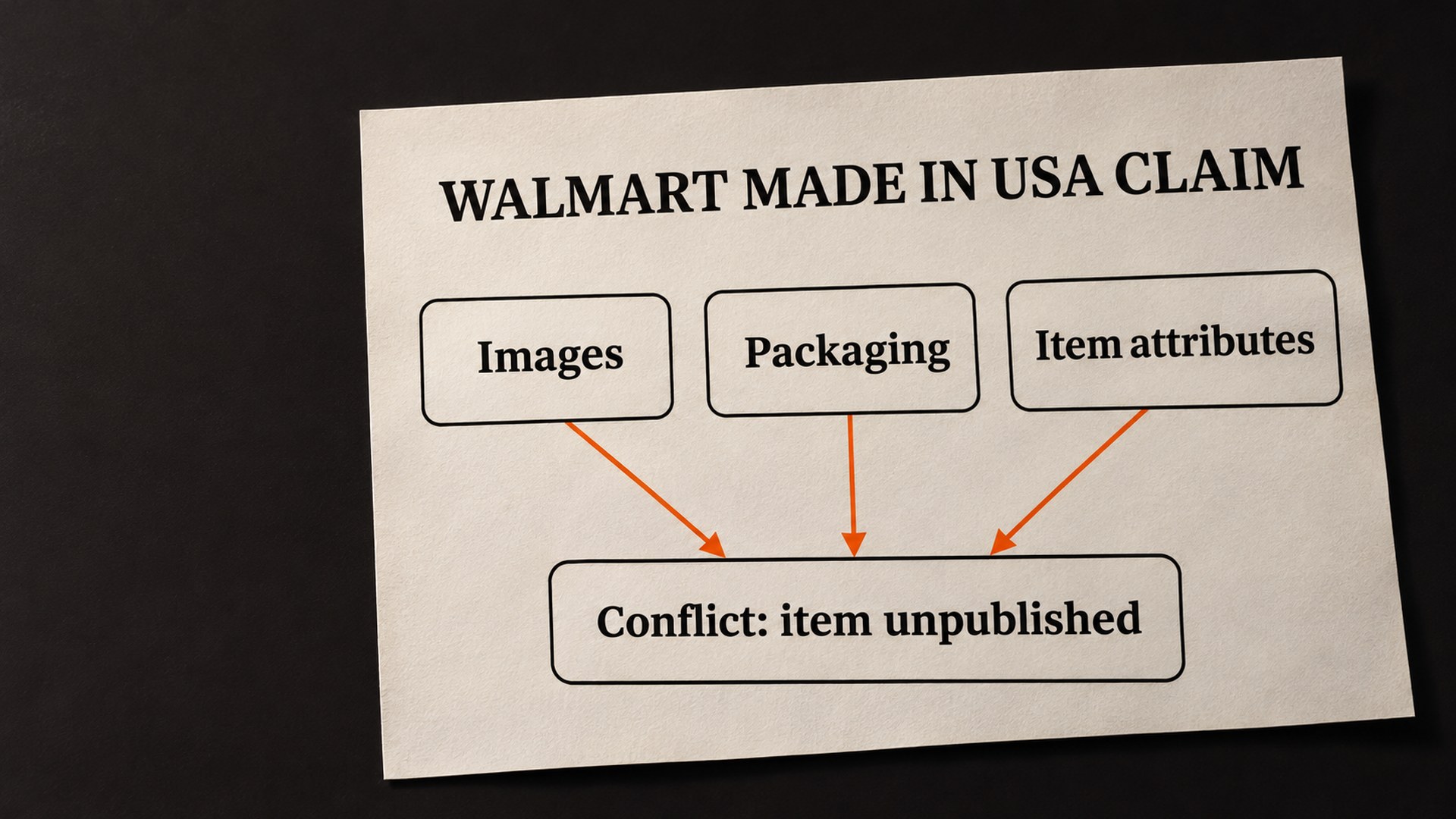
- Made in the USA: the claim has to be consistent across images, product packaging and item attributes. An item with conflicting information in its listing or details will be unpublished.
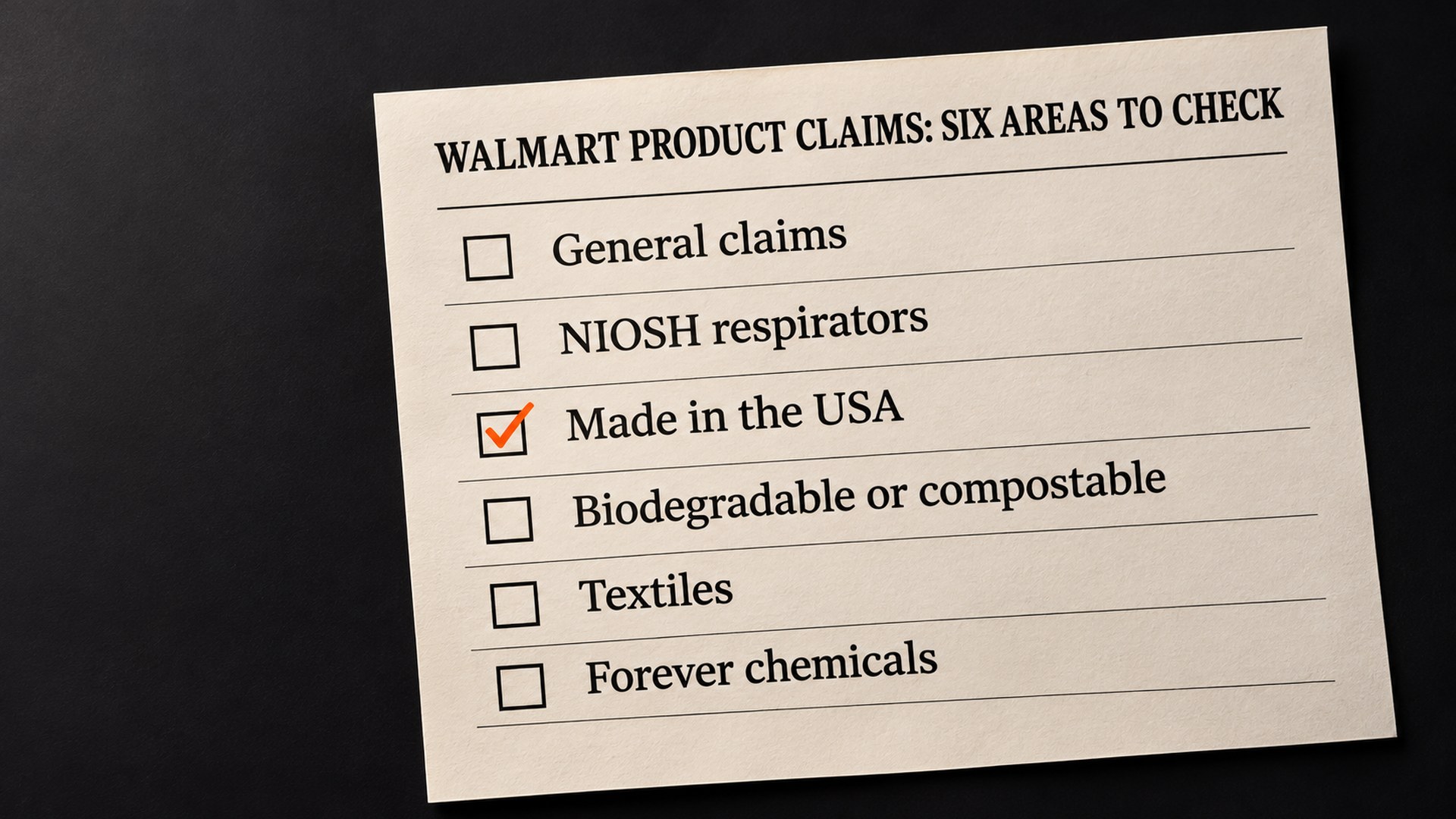
- Six areas: general claims, NIOSH respirators, Made in the USA, biodegradable or compostable, textiles and forever chemicals such as PFAS.
- The cheap check: put image, packaging, description and attribute side by side for every item that makes a claim. Fix the disagreement, or drop the claim.
- What Walmart does not say: the guide gives no republish timing and no appeal steps.
Walmart's product claims guide shows a last updated date of 5 November 2026, and its overview ends on a sentence that is worth reading slowly: "Products subject to our policy on Product claims must also adhere to other Prohibited Products Policies or Walmart will automatically unpublish your item." The overview sentence is about the other policies. For Made in the USA the guide's own line is that conflicting items "will be unpublished".
The Walmart product claims policy can take live items down, and the guide says nothing about warning you first. As I read it, a seller who copies listings over from Amazon, pastes in AI-written text or bulk uploads a catalog can end up with a Made in USA badge in the images and "imported" in an attribute, and Walmart treats the mismatch as the problem. In this guide I go through what the policy covers, how to tell whether a claim is what took an item down, and the order I would check your catalog in. It is aimed at brand owners who already sell on Walmart and are not sure which of their claims are exposed.
One limit up front. The guide describes the item being unpublished. It does not describe a way to appeal, so I will not describe one either, and I will say clearly where I am giving my own reading rather than Walmart's.
What does the Walmart product claims policy cover?
The guide opens with an overview and then splits into six areas. Walmart says all product listings must contain only truthful claims, subject to the necessary jurisdictional restrictions or prohibitions, and that this applies to all products and claim types. It lists the kinds of general claim it has in mind: air purification efficacy, "approvals" by third-party companies or agencies, heritage origins, jewelry or precious metal contents, magnification power, organic claims and textile contents.
The other five areas each get their own short section:
- NIOSH-approved respirators, masks and filters: an item that claims NIOSH approval without the appropriate approval information is prohibited from sale on the marketplace.
- Made in the USA: consistency across images, packaging and item attributes.
- Biodegradable or compostable: restricted for consumer products and for packaging, where applicable under federal, state and local laws.
- Textiles: labeling that follows the Federal Trade Commission's requirements.
- Forever chemicals: products containing PFAS, PFOS, PTFE, PFOA and similar chemicals are restricted.
Walmart lists separate policy pages for two of those, textiles and PFAS, under Related guides at the foot of the claims guide. Walmart's textiles and apparel policy and its PFAS chemicals policy are separate guides that were both last updated on 11 December 2025, so for those two areas the detail sits on their own pages.
Why does a Made in USA claim get an item unpublished?
This is the area where Walmart states the clearest test. Walmart requires any Made in the USA claim to be consistent across images, product packaging and item attributes. Any item with the claim "that is found to contain conflicting information within its listing or details will be unpublished."
Walmart's prohibited column has two entries. The first is any item claiming to be Made in the USA where substantial transformation happened outside the US, and it gives examples such as Made in America, Grown in the USA, Manufactured in USA, Assembled in America and Built in America. The second is an item that claims Made in the USA but also carries conflicting country of origin information, such as "imported" or a country that is not the USA. The allowed column is a single line: items that follow proper FTC labeling requirements for products claiming to be Made in the USA.
How a conflict gets in is my reasoning, not Walmart's. A listing has several authors. The images come from a designer, the packaging photo comes from the factory, the description comes from a copywriter or a tool, and the country of origin attribute comes from whoever filled in the item setup. Any two of them can disagree without anyone noticing, and none of them looks wrong on its own. The mismatch only exists when you read them together, and that is the only moment the conflict shows.
How to know if a claim took your item down
Start from the item, not the policy. Our Walmart listings unpublished guide covers where to find the reason Walmart gives and how to read each code. The product claims guide does not list a reason code of its own, so I cannot tell you which label a claims unpublish carries. What you can do is rule the pricing reasons in or out, then look at the claims.
- Rule out the price rules. If the reason points at price, you are in the territory of our reasonable price guide, and claims may not be the cause. An item can have more than one problem, so keep reading anyway.
- Ask whether the item makes a claim at all. Made in USA, Made in America, organic, compostable, PFAS-free, NIOSH, a heritage origin, a fiber content. If it says none of these anywhere, a claim conflict is less likely. Two parts of the policy do not depend on a claim, though: the general rule covers every claim type and not only these examples, and products that contain PFAS are restricted whether or not they say so. That is my reading of the guide.
- Look for the oldest copy of the claim. My reading, not Walmart's: items copied from an Amazon listing, written by an AI tool or loaded in a bulk file are the ones I would look at first, because a claim can travel with the text without anyone checking it against the packaging.
- Check the count. One item points at one conflict. Many items from one supplier or one bulk file usually share a source, though that is my reading and not something Walmart states.
What to check first
Cheapest first. The first three checks are reading and searching, and the last two are where a regulated product may need advice. If you find a PFAS-free line at any point, move it to the top.
1. List every item that makes a claim
Export your catalog and search the titles, descriptions and attributes for the claim words from Walmart's own list. You are building a short list of exposed items, not auditing the whole catalog.
2. Put the four places side by side
For each Made in USA item, read the images, the packaging photo, the description and the country of origin attribute in one row. Walmart names images, packaging and item attributes. I add the description as a fourth, because it is an easy place for AI-written text to add a claim nobody asked for. Any disagreement, including a small one, is the item to fix first.
3. Search for the restricted environmental words
Biodegradable, degradable, compostable and decomposable, in any form, on the product or on its packaging. Walmart restricts consumer products and packaging that claim these, where applicable under federal, state and local laws, and its restricted column also covers products that make environmental claims about the biodegradability, degradability or compostability of the item, so those four words are examples and not the whole list. Walmart says consumer products with no such claims are allowed. For a phrase like "eco-friendly packaging" I would read it against that wider wording and not assume it is safe. If you also sell in Europe, our environmental claims guide for EU listings covers that side.
4. Check the regulated categories separately
Respirators, masks and filters, textiles and anything that could contain forever chemicals each have their own bar. For NIOSH items Walmart says the listing must display the approval holder name, the model or part number, the protection or filter designation, the approval number where applicable and the acronym NIOSH, with a lot number recommended but not required, plus images of all sides of the retail packaging that show manufacturer information, where applicable. For textiles, Walmart's policy also requires compliance with Consumer Product Safety Commission rules, and says the information these laws require, including fiber content, country of origin and the identity of the responsible business, must be shown to the customer on the website listing. For PFAS, the restriction applies to covered products with intentionally added PFAS in the states that restrict their sale, and Walmart's PFAS table also lists any covered product that contains intentionally added PFAS as prohibited without naming a state, so do not assume a state you do not ship to keeps you clear. Covered products vary by state, Walmart says it is the seller's responsibility to confirm whether a product is subject to PFAS laws in any state it may ship to, and it says to ask your own legal counsel if you are unsure. I am not a lawyer and neither is the guide, which says plainly that its third-party information is not legal advice.
5. Read the PFAS-free wording twice
In my reading, a PFAS-free line looks like a careful claim, and Walmart prohibits it. Walmart's PFAS policy prohibits products that carry "PFAS-Free", "PFOA-Free", "PFOS-Free", "PTFE-Free" or a similar claim in the title, description or images. A "Free of Intentionally Added PFAS" claim made without a valid certificate of conformance from the manufacturer is also prohibited, and one the seller can substantiate with that certificate is allowed. Cookware that contains intentionally added PFAS is allowed with restriction, provided the chemical is disclosed on the product label, including on the product listing for online sales. If you have a "PFAS-free" line in a title today, I would deal with that before any other claim on this list.
How it gets fixed
The fix follows the claim, and the order matters more than the speed.
If the claim is true and the listing disagrees with itself, make the four places say the same thing. I would start with the attribute, because, in my reading, a bulk upload is the step most likely to overwrite it unnoticed. Then recheck the images, since an old photo with a different origin line on the label counts as a conflict too.
If the claim is not true, or you cannot show it, remove it from every place it appears. Walmart prohibits Made in USA claims, Assembled in America among them, where substantial transformation took place outside the US. I would not try to word around that. Removing the claim is the simpler path, and keeping a claim you cannot back up is the risk.
If the claim is a biodegradable or compostable one, the simplest route is to take the term off the product and the packaging, since Walmart allows consumer products without such claims.
If the item is already unpublished, fix the conflict first and then check its status in Seller Center. I cannot give you a republish time, because the claims guide does not state one. Our unpublished listings guide gives the 48 hour figure Walmart quotes for the pricing reasons, and that figure is not a promise for claims, so do not plan around it.
How to stop it happening again
In my view a claim conflict is a process problem more than a one-off mistake, so prevention is about who can change a claim and where it lives.
- One owner per claim: a single person decides whether Made in USA is true for a product, and everyone else copies it from them.
- A check before every bulk upload: I would expect a bulk file to carry its own attribute values, so an old "imported" value can come back after you fixed it.
- A second look at anything an AI tool wrote: a tool can add "proudly made in America" to a description because it sounds right, and Walmart's rule covers conflicting information within the listing or details.
- A recheck when a supplier changes: a new factory can change where substantial transformation happens, and the claim can stop being true on the day the purchase order changes.
- A date on the policy: the guide was updated on 5 November 2026 and the other two policies on 11 December 2025. Note the date you last read each one, so you can see when a page has changed.
If you also plan to fulfil Walmart orders from Amazon stock, our multichannel selling guide covers the Walmart packaging and carrier rule for those orders.
Get a second pair of eyes on your Walmart catalog claims
The slow part of this problem is not the fix. It is finding the items where an image, a packaging photo and an attribute disagree. That is the kind of catalog read we do for Walmart sellers through our Walmart seller services: we check listings for compliance risks, including claims that disagree across images, packaging and attributes. I cannot promise what Walmart will decide about any single item. If you sell on Amazon too, our free Amazon listing audit takes one ASIN link and does not look at Walmart listings or claims. For the Walmart claims read, get in touch through the Walmart seller services page.
Common questions about the Walmart product claims policy
What does the Walmart product claims policy cover?
Walmart's product claims guide covers general product claims, NIOSH-approved respirators, masks and filters, Made in the USA, biodegradable or compostable claims, textiles and forever chemicals. It says all listings must contain only truthful claims that are subject to necessary jurisdictional restrictions or prohibition.
Will Walmart unpublish an item for conflicting Made in USA information?
Yes. Walmart's guide says any item with a Made in the USA claim that is found to contain conflicting information within its listing or details will be unpublished. It requires the claim to be consistent across images, product packaging and item attributes.
Can I say Assembled in America on Walmart?
Walmart's guide prohibits any item claiming to be Made in the USA where substantial transformation happened outside the US, and it gives Assembled in America, Built in America, Made in America, Grown in the USA and Manufactured in USA as examples of such claims. Items that follow proper FTC labeling requirements for Made in the USA claims are allowed. If you are unsure which side your product falls on, ask your own legal counsel.
Are biodegradable and compostable claims allowed on Walmart?
Walmart restricts consumer products and product packaging that claim to be biodegradable, degradable, compostable or decomposable, in any form of those terms, and products making other environmental claims about biodegradability, degradability or compostability, where applicable under federal, state and local laws. Consumer products that carry no such claims are allowed.
What does a NIOSH claim need on a Walmart listing?
Walmart says an item claiming NIOSH approval must show the approval holder name, the model or part number, the protection or filter designation, the NIOSH approval number where applicable and the acronym NIOSH. A lot number is recommended but not required, and Walmart lists images of all sides of retail packaging that show manufacturer information, where applicable. Items that claim approval without the appropriate information are prohibited from sale on the marketplace.
How long does Walmart take to republish an item after a claims conflict?
The product claims guide does not say. It states that conflicting items will be unpublished and gives no republish timing or appeal steps, so treat any timeline you read elsewhere as unconfirmed for this policy.
Can I put PFAS-free on a Walmart listing?
Walmart's PFAS policy prohibits products with a "PFAS-Free", "PFOA-Free", "PFOS-Free", "PTFE-Free" or similar claim in the title, description or images. A "Free of Intentionally Added PFAS" claim is allowed only if the seller can substantiate it with a valid certificate of conformance from the manufacturer. Ask your own legal counsel if you are unsure which rule applies to your product.
Sources
- Prohibited Products Policy: Product claims, Walmart Marketplace Learn (US)marketplacelearn.walmart.com
- Prohibited Products Policy: Textiles and Apparel, Walmart Marketplace Learn (US)marketplacelearn.walmart.com
- Prohibited Products Policy: PFAS Chemicals, Walmart Marketplace Learn (US)marketplacelearn.walmart.com
Founder, AVA INC.
Shilpi Dudani is the founder of AVA INC. Her team manages Seller Central accounts, fixes catalog problems and optimizes listings for Amazon sellers.
Not sure whether this is your problem?
We will look at your account and tell you what is actually wrong before you spend anything.
Get your free, no-obligation audit